BSc(Hons) Physiotherapy
This course is open to applications. However, please be aware that we are currently experiencing a high demand for this course and are unable to guarantee that we will be able to review applications submitted after the UCAS equal consideration deadline for September 2026/27 entry.
Accreditations and partnerships:



96% of Physiotherapy students are satisfied with the teaching of their course overall.Guardian University Guide 2026
90% of Physiotherapy graduates were in graduate-level employment or further study 15 months after graduating. The Sunday Times Good University Guide 2026
Once you have graduated you can apply for registration with the Health and Care Profession Council, a pre-requisite for working as a physiotherapist. You will also be eligible to apply for membership of the Chartered Society of Physiotherapy.
About
Why study physiotherapy?
Working as part of a multidisciplinary healthcare team either in an NHS, independent or charity hospital or in the community physiotherapists help to maintain and restore movement and function in people affected by injury, illness or disability.
It's varied, stimulating and rewarding work. There's always a need for skilled physiotherapists who know how to deliver safe, effective care in a way that promotes physical, psychological and social wellbeing.
A £5,000 per year training grant is available for home students. Further information is available on the NHS Business Services website.
Why UWE Bristol?
BSc(Hons) Physiotherapy is approved by the Health and Care Professions Council (HCPC) and the Chartered Society of Physiotherapy (CSP) which means you will be eligible to apply for registration as a physiotherapist with both once you graduate - something you'll need to do to practise in this field.
With work-based training built in, and outstanding onsite facilities, you'll learn what constitutes good physiotherapeutic practice, and explore the theories and subjects that influence it.
Develop a holistic approach to your practice and learn from an inspirational, supportive team with a depth of physiotherapy experience in many areas.
Discover how to work with patients, their families and other healthcare professionals to support rehabilitation and wellbeing developing your inter-professional and interpersonal skills.
The course has a strong practical focus, incorporating case-based learning and opportunities to engage with patients and professionals on placements, in class and online.
You'll spend about a third of your time on placements in the NHS, and with specialist independent and voluntary sector employers, in a mix of environments.
Where can it take me?
Physiotherapists are in demand across the UK, so there are lots of exciting job opportunities.
You could work in a hospital or the community for the NHS or independent sector, in private practice, in sports and leisure centres, or for private or voluntary sector employers.
Find out where a career in allied health professions can take you.
Entry
Typical offers
You will need to meet the following Level 2 requirements:
- GCSE: Grade C/4 or above in English, Mathematics and Double Science, or equivalent.
In addition to the above Level 2 qualifications, you'll need to achieve the published tariff points from your Level 3 studies prior to entry. Below is an indicative list of the main qualification types. However, we will consider any Level 3 qualifications towards meeting our entry requirements.
- Tariff points: 128
- Contextual tariff: See our contextual offers page.
- English Language Requirement:
International and EU applicants are required to have a minimum overall IELTS (Academic) score of 7.0 with 6.5 in each component (or approved equivalent*).
*The university accepts a large number of UK and International Qualifications in place of IELTS. You can find details of acceptable tests and the required grades you will need in our English Language Requirements.
- A-level subjects: Grade B in Biology, Human Biology or PE. 120 points from A2 subjects.
- EDEXCEL (BTEC) Diploma: You'll need a minimum of five units in Biology, Human Biology, PE, Sport or Sport and Exercise. You may be asked to do more based on the size of your units.
Examples of BTEC units that meet our Biology requirement include: Biology, Anatomy, Physiology, Sports Injury, Biomechanics, Nutrition, Genetics, Disease and Microbiology.
We'll accept Extended Diplomas in Sport and Exercise Science and Applied Science. We'll not accept any other BTEC qualifications in Sport.
Please list the units you're studying in your application. For further advice on acceptable units, please email Admissions (contact details below).
For information on required Guided Learning Hours please see our minimum entry requirements page.
- Access: 15 Level 3 credits at Distinction in Biology.
- Baccalaureate IB: A minimum grade 6 in Higher Level Biology or Human Biology. We accept the IB Career-related Programme in conjunction with other Level 3 qualifications.
- Irish Highers: H1 in Biology or Human Biology.
- Welsh Baccalaureate: We accept tariff points achieved from the Advanced Skills Baccalaureate Wales in conjunction with other Level 3 qualifications. This qualification cannot be used to satisfy any subject specific entry requirements.
- Cambridge Technical: You will need a minimum of five units in Biology or Human Biology. You may be asked to do more based on the size of your units. Please email Admissions a list of your units for further clarification. We will accept Cambridge Technical Extended Diploma in Sport and Physical Activity.
- T Levels: Science and Healthcare Science.
If you partially achieve your T Level, you can meet our subject requirements if you have at least a C in your Core Section. For further advice on acceptable subjects please email us.
Other qualifications that meet the Level 3 Biology requirement are:
- BTEC National Extended Certificate in Applied Human Biology at distinction
- WJEC Level 3 Medical Science Diploma at grade B (40 UTP).
Selection process
Shortlisted applicants will be invited to an online interview. For more details on the process, please visit our selection page.
Entry requirements
Please note that due to early clinical contact on this course applicants must turn 18 before the start of placement. Applicants who do not turn 18 by the commencement of the placement will be advised to defer or reapply as appropriate. Please see our admissions policy for further information.
We will be looking for applicants who can clearly demonstrate a good understanding of the profession and why physiotherapy is your chosen career path.
If you don't meet the entry requirements of this course, you may be eligible for the Health Professions Foundation Year.
Additional requirements
Before you start your course, you'll be required to complete:
- an enhanced Disclosure and Barring Service (DBS) Check
- a Health Check.
Read more about professional checks.
International applicants
If you're applying to UWE Bristol from another country or region, visit the international study pages for tailored application information. If you're an international student and don't meet the academic requirements to study this course, you can qualify by completing preparatory study at our International College.
If you're applying to study at UWE Bristol and require additional support to meet our English language requirements, you may be able to attend one of our pre-sessional English courses. Read more about our Pre-sessional English Programme.
Deferred entry
We'll accept deferred entry applications for this course.
Read more about entry requirements.
How to apply
If you've not received a decision on your application within a week of the interview, this means that the University is still considering your application. We appreciate your patience during this time and would like to remind you that if you applied through UCAS and have received offers from any other Universities, you'll not lose these offers before your UCAS Reply Deadline.
Read more about undergraduate applications.
Read more about international applications and key international deadline dates.
For further information
- Email:
UK applicants
Admissions@uwe.ac.ukInternational/EU applicants
International@uwe.ac.uk - Telephone:
UK applicants
+44 (0)117 32 83333International/EU applicants
+44 (0)117 32 86644
Structure
Content
Year one
You'll study:
- Physiotherapy Practice 1: Essential Skills
- Clinical Anatomy and Kinesiology for Physiotherapy and Sport Rehabilitation
- Fundamentals of Human Anatomy and Physiology
- Essentials of Musculoskeletal Physiotherapy
- Essentials of Neuroscience for Physiotherapy
- Essentials of Respiratory Physiotherapy.
Year two
You'll study:
- Physiotherapy Practice 2b
- Informing Practice through Research and Inquiry
- Physiotherapy Across the Lifespan
- Clinical Reasoning for Musculoskeletal Physiotherapy and Practice 2a
- Clinical Reasoning for Neurological Physiotherapy
- Clinical Reasoning for Cardiorespiratory Physiotherapy.
Final year
You'll study:
- Physiotherapy Practice 3
- Research and Evidence in Practice
- Healthy Futures
- Consolidation of Learning into Practice
- Complex Clinical Reasoning for Neurological and Musculoskeletal Physiotherapy
- Complex Clinical Reasoning: Management of the Critically Ill Patient.
The University continually enhances our offer by responding to feedback from our students and other stakeholders, ensuring the curriculum is kept up to date and our graduates are equipped with the knowledge and skills they need for the real world. This may result in changes to the course. If changes to your course are approved, we'll inform you.
Learning and Teaching
Gain a deep grounding in professional and health-related studies through a balanced mix of theory, clinical reasoning and problem solving that gives you a strong foundation for clinical practice.
Develop your understanding of physiotherapeutic practice, and how to take an integrated approach to patient-client management.
Develop your critical thinking and research skills. Explore current themes and issues in contemporary physiotherapy and healthcare. Get access to the latest research and work on your own research project or literature review.
Develop as an autonomous practitioner who can implement safe and effective assessment, examination and treatment in a wide range of settings.
See our full glossary of learning and teaching terms.
Assessment
You'll be assessed using a mixture of coursework, professional practice assessment, presentations, and practical and written examinations.
We make sure the assessments are well spread out throughout the course, so you're not overloaded.
Fees
Full time course
Indicative Additional Costs
Supplementary fee information
Additional costs are for items you could need during your studies that aren't covered by the standard tuition fee. These could be materials, textbooks, travel, clothing, software or printing.
A £5,000 per year training grant is available for home students. Further information is available on the NHS Business Services website.
Features
Professional accreditation
This course is approved by the Health and Care Professions Council (HCPC), which means you will be eligible to apply for registration as a physiotherapist with them when you graduate, a prerequisite for practice. The course is also accredited by the Chartered Society of Physiotherapy (CSP), which you can also apply to join after you've graduated.
Placements
Students who gain work experience tend to graduate with better degrees. Experience Placements also hone your skills, industry knowledge and professional network, making you a sought-after graduate.
With 30 weeks of work placements, you'll spend a third of the course applying your knowledge and building professional skills in the workplace.
We have excellent links with leading employers across the South West, including the NHS, and private and voluntary sector organisations.
UWE Bristol's geographical area for placement provision covers the whole of the South, South West and West of England. Placements across this region help support and provide a wealth of clinical experience across many areas within the NHS healthcare service and the Private Voluntary and Independent sector. These placements are vital to meet the professional regulatory body standards in practice for our affiliated health and social care courses.
To access this variety of opportunities within the health and social care courses, there's an expectation that all students at times will have to travel across large areas. In some cases this can be more than 50 miles away and may be outside of normal working hours due to the nature of shift work on some courses.
When considering your application to these courses, you must ensure you have means to travel to your placement location at unsociable hours, and/or funds available to secure short-term accommodation options to participate in your placement, if required.
Study facilities
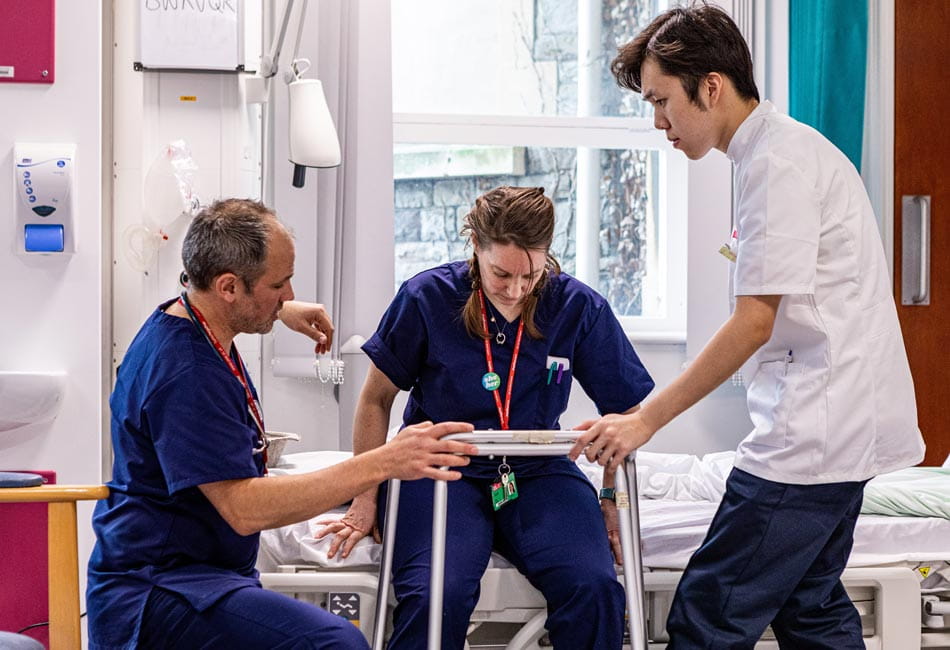
Practise manual therapy and physiotherapeutic skills in our well-equipped practical rooms, with hydraulic couches and teaching aids such as skeletons and anatomical models.
Hone your skills using our simulation facilities.
The Glenside Campus Library has one of the best healthcare libraries in the country, with a huge selection of books, journals, audio-visual materials and specialist healthcare software.
Take a personalised virtual tour of the Physiotherapy, Occupational Therapy and Rehabilitation facilities and experience what a typical day could look like here for you.
Personalised virtual tour
There's no need to visit us in person to explore our facilities and campuses. Take a personalised virtual tour and discover it all for yourself from wherever you are.
Take a virtual tourCareers
Careers / Further study
You'll be well equipped to practise physiotherapy in the NHS, industry, private practice, sports and leisure centres, in the UK and overseas.
Many physiotherapists work in hospitals and the community, specialising in outpatients' departments, intensive care, stroke services, orthopaedics, elderly care and paediatrics. You might provide treatment and advice for patients and carers in their homes, in nursing homes, day centres, schools or health centres.
Some graduates also choose careers in teaching or research, or continue with postgraduate studies.
Get inspired
Our award-winning careers service will develop your employment potential through career coaching and find you graduate jobs, placements and global opportunities.
We can also help find local volunteering and community opportunities, provide support for entrepreneurial activity and get you access to employer events.
Visit our employability pages to learn more about careers, employers and what our students are doing six months after graduating.
See also:
Life

Accommodation
An excellent range of options for all of the Bristol campuses and the city centre.

Bristol
A stunning city for student living with all the qualities to make you want to stay.

Sports, societies and activities
There is more to your experience here than study. Choose to make the most of it and try new things.

Health and Wellbeing
We provide support in the way you need it.

Campus and facilities
Discover our campuses and the wealth of facilities provided for our students.