BSc(Hons) Midwifery
Please note this course is closed to new applications from Home applicants for September 2026 entry
Accreditations and partnerships:
91% of Nursing graduates were in graduate-level employment or further study 15 months after graduating. The Sunday Times Good University Guide 2026
Our employer links, practical focus and the clinical experience offered means that 95% of our graduates are in work or further study six months after graduation.
About
Why study midwifery?
Midwives are autonomous practitioners providing care and support to service-users and their families during pregnancy, birth and the early postnatal period.
Working as part of a multidisciplinary professional team, midwives practise in birth units, communities and hospitals, supporting service-users to have a positive experience of childbirth.
This dynamic, demanding and privileged role carries great responsibility but is incredibly rewarding.
A £5,000 per year training grant is available for home students. Further information is available on the NHS Business Services website.
Why UWE Bristol?
BSc(Hons) Midwifery is accredited by the Nursing and Midwifery Council (NMC), which means you can register as a midwife with them when you graduate.
With close input from practice partners and maternity service users, the course offers an authentic, woman-centred learning experience and gives you the grounding you need to practise midwifery confidently, compassionately and to the highest standard.
Cement your understanding of the midwife's role and learn about good midwifery practice. Develop the critical thinking and leadership skills to evaluate evidence, and help move midwifery forward.
Based at our Glenside campus UWE Bristol's home of health and social care you'll develop strong interpersonal and inter-professional skills to work in a team with service-users, their families and healthcare professionals from other disciplines.
Work with enthusiastic academics who've all practised as midwives themselves.
The course has a strong practical focus and you'll spend around half of your time learning on clinical placements, supported by midwifery mentors.
Engage with service users, practising midwives, researchers and other healthcare professionals in placements, class and online.
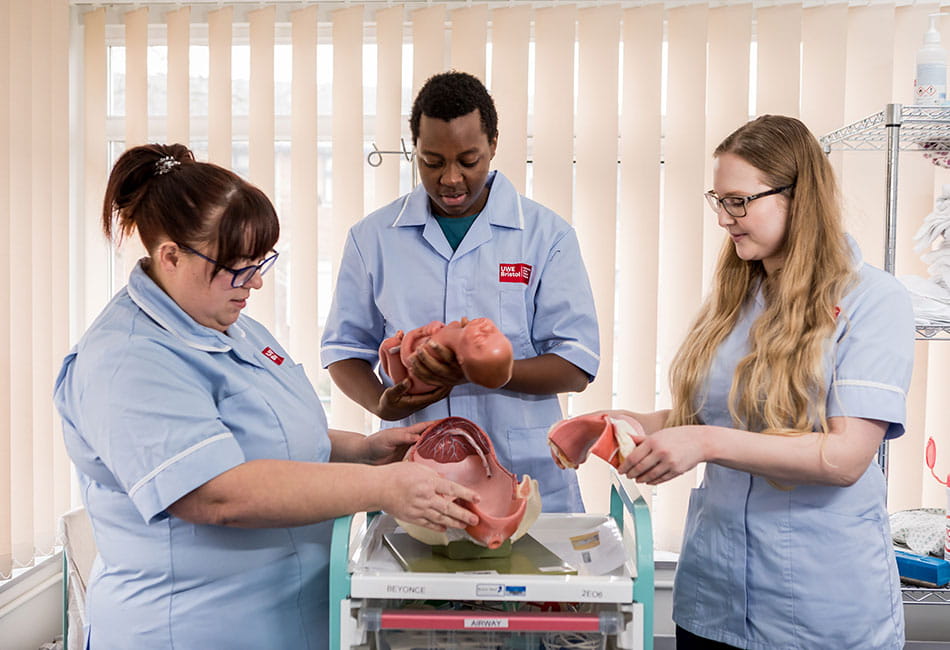
Practise and hone your skills with medical students in hospital settings, and in our purpose-built Skills and Simulation Centre and Birth Room.
Where can it take me?
Midwives are in demand across the UK. Your skills will be sought after in both hospital and community-based roles.
You could progress to become a specialist or consultant midwifery practitioner, clinical midwifery manager, lecturer or researcher in midwifery.
Find out where a career in midwifery can take you.
Inspirational Midwives
Entry
Typical offers
You will need to meet the following Level 2 requirements:
- GCSE: Grade C/4 or above in English, Mathematics and Science, or equivalent.
In addition to the above Level 2 qualifications, you'll need to achieve the published tariff points from your Level 3 studies prior to entry. Below is an indicative list of the main qualification types. However, we will consider any Level 3 qualifications towards meeting our entry requirements.
- Tariff points: 120
- Contextual tariff: See our contextual offers page.
- English Language Requirement:
International and EU applicants are required to have a minimum overall IELTS (Academic) score of 7.0 or above with a minimum of 6.5 in writing, and 7.0 in all other sections of the test (or approved equivalent*).
*The university accepts a large number of UK and International Qualifications in place of IELTS. You can find details of acceptable tests and the required grades you'll need on the English Language requirements page.
- A-level subjects: Grade C or above in a Science, Health or Social Science subject.
- Relevant subjects: Subjects that meet the Science/Social Science requirement for this course: Biology, Applied Biology, Human Biology, Chemistry, Physics, Psychology, Applied Science, Science (Biology route), Science (Chemistry route), Science (Physics route), Sociology, Health and Social Care.
- EDEXCEL (BTEC) Diploma: You'll need a minimum of five units in a Science, Health or Social Science Subject. You may be asked to do more based on the size of your units. Please list the units you are studying in your application. For further advice on acceptable units, please email us.
For information on required Guided Learning Hours please see our minimum entry requirements page.
- Access:
15 Level 3 credits at Merit in a Science, Health or Social Science subject.
- Baccalaureate IB:
A minimum Grade 5 in a Higher Level Science, Health or Social Science subject. Irish Highers: H2 in a Science or Social Science subject. We accept the IB Career-related Programme in conjunction with other Level 3 qualifications.
- Irish Highers: H2 in a Science or Social Science subject.
- Welsh Baccalaureate: We accept tariff points achieved from the Advanced Skills Baccalaureate Wales in conjunction with other Level 3 qualifications. This qualification cannot be used to satisfy any subject specific entry requirements.
- Cambridge Technical: You'll need a minimum of five units in a Science, Health or Social Science Subject. You may be asked to do more based on the size of your units. Please list the units you are studying in your application. For further advice on acceptable units, please email us.
For information on required Guided Learning Hours please see our minimum entry requirements page.
- T Levels: Health, Healthcare Science or Science. If you partially achieve your T Level, you can meet our subject requirements if you have at least a C in your Core Section. For further advice on acceptable subjects please email us.
Selection process
Shortlisted applicants will be invited to an online interview. For more details on the process, please visit our selection page.
Entry requirements
Please note that due to early clinical contact on this course applicants must turn 18 before the start of placement. Applicants who do not turn 18 by the commencement of the placement will be advised to defer or reapply as appropriate. Please see our admissions policy for further information.
If you don't meet the entry requirements of this course, you may be eligible for the Health Professions Foundation Year.
Additional requirements
Before you start your course, you'll be required to complete:
- an enhanced Disclosure and Barring Service (DBS) Check
- a Health Check.
Read more about professional checks.
International applicants
If you're applying to UWE Bristol from another country or region, visit the international study pages for tailored application information. If you're an international student and don't meet the academic requirements to study this course, you can qualify by completing preparatory study at our International College.
If you're applying to study at UWE Bristol and require additional support to meet our English language requirements, you may be able to attend one of our pre-sessional English courses. Read more about our Pre-Sessional English Programme.
Deferred entry
We accept deferred entry applications for this course.
Read more about entry requirements.
How to apply
If you've not received a decision on your application within a week of the interview, this means that the University is still considering your application. We appreciate your patience during this time and would like to remind you that if you applied through UCAS and have received offers from any other Universities, you'll not lose these offers before your UCAS Reply Deadline.
Read more about undergraduate applications.
Read more about international applications and key international deadline dates.
For further information
- Email:
UK applicants
Admissions@uwe.ac.ukInternational/EU applicants
International@uwe.ac.uk - Telephone:
UK applicants
+44 (0)117 32 83333International/EU applicants
+44 (0)117 32 86644
Structure
Content
Year one
You'll study:
- The Context of Midwifery Practice 1
- The Context of Midwifery Practice 2
- Holistic Midwifery Practice 1
- Holistic Midwifery Practice 2
- The Midwife as a Skilled Practitioner 1.
Year two
You'll study:
- The Context of Midwifery Practice 3
- The Context of Midwifery Practice 4
- Holistic Midwifery Practice 3
- Holistic Midwifery Practice 4
- The Midwife as a Skilled Practitioner 2.
Final year
You'll study:
- Holistic Midwifery Practice 5
- Holistic Midwifery Practice 6
- Promoting Excellence for Midwifery Practice
- The Midwife as a Skilled Practitioner 3.
The University continually enhances our offer by responding to feedback from our students and other stakeholders, ensuring the curriculum is kept up to date and our graduates are equipped with the knowledge and skills they need for the real world. This may result in changes to the course. If changes to your course are approved, we'll inform you.
"I gained skills in a simulated environment, which I put into practice on my placements. After graduating, I landed my first job at the same Trust where I completed my placements. This experience has led me to my current role as a Core Midwife in a Continuity of Carer team." Sarah, Midwifery graduate
Learning and Teaching
We use a mix of lectures, workshops, group work, case studies, projects and IT-based activities, tutorials, skills sessions and simulation exercises, to develop your skills and get you ready for practice.
Explore all aspects of midwifery care in the contexts of both normality and the complexities of pregnancy and childbirth.
Develop your expertise in communication in a diverse world.
Learn about inter-professional working, and the professional practice of midwifery, drawing evidence from your placements and dissertation. Grow into an independent, reflective learner.
The placements will link the theory with practice, and expose you to clinical scenarios, problem solving, judgement and decision making, to prepare you for your role as a practising midwife.
See our full glossary of learning and teaching terms.
Get involved
Join our Midwifery Society to take part in extra-curricular opportunities and support networks.
Run by student midwives, the society organises topical external speakers, social events and activities where you can meet peers, collaborate and share experiences.
Study time
You'll spend half the course studying at university and the other half on clinical placements.
Assessment
We'll assess the theoretical and clinical parts of the course using a mixture of unseen examinations, reflective portfolios, structured clinical examinations, clinical assessments and a literature-based dissertation.
Learn more about assessments.
Fees
Full time course
Indicative Additional Costs
Supplementary fee information
Additional costs are for items you could need during your studies that aren't covered by the standard tuition fee. These could be materials, textbooks, travel, clothing, software or printing.
A £5,000 per year training grant is available for home students. Further information is available on the NHS Business Services website.
Features
Professional accreditation
This course is accredited by the Nursing and Midwifery Council (NMC). You can register as a midwife with them when you graduate.
Placements
UWE Bristol's geographical area for placement provision covers the South West and West of England. Placements across this region help support and provide a wealth of clinical experience to many areas within the NHS healthcare service and the Private Voluntary and Independent sector. These placements are vital to meet the professional regulatory body standards in practice for our affiliated health and social care courses.
To access this variety of opportunities within the health and social care courses, there's an expectation that all students at times will have to travel across large areas. In some cases this can be more than 50 miles away, and may be outside of normal working hours due to the nature of shift work on somecourses.
When considering your application to these courses, you must ensure you have means to travel to your placement location at unsociable hours, and/or funds available to secure short-term accommodation options to participate in your placement, if required.
You'll spend half the course applying your knowledge and building professional skills on midwifery practice environments.
We have excellent links with NHS Trusts and other health and care organisations throughout the South West.
You'll work in midwifery-led birth units, hospital and community settings, caring for service-users from diverse social and cultural backgrounds and learning to manage a midwifery caseload.
Your broad range of practice experiences, working with qualified midwives in hospital and community settings, will put you in a strong position for future employment.
Your personal mentor will advise, counsel and give you feedback on your progress during your placements.
Placement opportunities are spread evenly across the academic year and are provided for each year you study with us.
Study facilities
The Glenside campus library is one of the best healthcare libraries in the country with a huge selection of books, journals, audio-visual materials and specialist health and social care software to support your studies.
Practise your professional skills in our advanced Skills and Simulation Centre and Birth Room.
Learn to manage emergency situations in the home in our specially-adapted Simulation House.
Learn more about UWE Bristol's facilities and resources.
Take a personalised virtual tour of the Nursing and Midwifery facilities and experience what a typical day could look like here for you.
Personalised virtual tour
There's no need to visit us in person to explore our facilities and campuses. Take a personalised virtual tour and discover it all for yourself from wherever you are.
Take a virtual tourCareers
Careers / Further study
Midwives are in demand across the UK and graduates enter careers in a wide variety of roles for the NHS and independent sector employers.
We have close links with our NHS partners, who are the main employers of midwifery graduates.
Once qualified, you can choose to progress into specialist areas, such as working with service-users who misuse drugs or alcohol.
You could also become a specialist midwifery practitioner in areas such as infant feeding, management, lecturing or research.
Graduate midwives continue their professional development throughout their career, and there are many post-qualifying courses to support this.
Get inspired
Our award-winning careers service will develop your employment potential through career coaching and find you graduate jobs, placements and global opportunities.
We can also help find local volunteering and community opportunities, provide support for entrepreneurial activity and get you access to employer events.
Visit our employability pages to learn more about careers, employers and what our students are doing six months after graduating.
Listen to why Sarah chose to study midwifery at UWE Bristol.
See also:
Start your dream career at UWE Bristol
Life

Accommodation
An excellent range of options for all of the Bristol campuses and the city centre.

Bristol
A stunning city for student living with all the qualities to make you want to stay.

Sports, societies and activities
There is more to your experience here than study. Choose to make the most of it and try new things.

Health and Wellbeing
We provide support in the way you need it.

Campus and facilities
Discover our campuses and the wealth of facilities provided for our students.