BSc(Hons) Psychology
This course is open for applications
Accreditations and partnerships:

This course is accredited by the British Psychological Society and has a strong practical focus that will build your professional skills, enhance your CV and get you noticed by employers.
About
Why study psychology?
Psychology gives us the tools to investigate and understand human thought, action and behaviour.
Combining a scientific approach, with the ability to think creatively, it's a subject that builds psychological literacy and strong practical skills that are essential for success in the workplace.
Psychology graduates now work in every area of society, using their numeracy, IT literacy, communication and problem-solving capabilities to add value in their professions.
Why UWE Bristol?
BSc(Hons) Psychology is accredited by the British Psychological Society (BPS), so you'll have the opportunity to obtain the Graduate Basis for Chartered Membership (GBC) alongside your degree. That's the initial recognised standard you need to become a practising psychologist.
Built around the core BPS curriculum, the course will help you apply academic knowledge to real-world situations learning from internationally-recognised researchers and practitioners.
One of the modules on the course is accredited by the Institute of Leadership and Management (ILM).
You'll gain advanced psychological knowledge and valuable transferable skills, becoming a strong communicator and problem solver.
Hands-on experience with psychological measures and equipment and approaches in practical sessions will develop your knowledge further.
Mentored by a personal tutor, you'll undertake work-based learning, have the opportunity to go on a placement, and participate in research projects. In your final year, you'll complete an independent research project in an area of your interest.
If you choose to do a sandwich year placement, you'll spend a year working in a public, private or voluntary sector organisation between your second and final year. If you choose to do Study Year Abroad, you'll spend the same period of time studying at an appropriate overseas institution.
Where can it take me?
The transferable skills and industry experience you'll gain will make you attractive to a wide range of employers.
You could take your skills into healthcare, law enforcement, finance, IT, research, government, education, the creative industries or the legal sector.
You'll have the confidence, communication and team-working skills to make a positive impact in any organisation.
Watch: Welcome to the School of Social Sciences at UWE Bristol
Entry
Typical offers
You will need to meet the following Level 2 requirements:
- GCSE: Grade C/4 or above in English, Mathematics and Double Science, or equivalent.
In addition to the above Level 2 qualifications, you'll need to achieve the published tariff points from your Level 3 studies prior to entry. Below is an indicative list of the main qualification types. However, we will consider any Level 3 qualifications towards meeting our entry requirements.
- Tariff points: 128
- Contextual tariff: See our contextual offers page.
- English Language Requirement:
International and EU applicants are required to have a minimum overall IELTS (Academic) score of 6.0 with 5.5 in each component (or approved equivalent*).
*The university accepts a large number of UK and International Qualifications in place of IELTS. You can find details of acceptable tests and the required grades you'll need in our English Language section. Please visit our English language requirements page.
- A-level subjects: No specific subjects required.
- EDEXCEL (BTEC) Diploma: No specific subjects required.
For information on required Guided Learning Hours please see our minimum entry requirements page.
- Access: No specific subjects required.
- Baccalaureate IB: No specific subjects required. We accept the IB Career-related Programme in conjunction with other Level 3 qualifications.
- Irish Highers: No specific subjects required.
- Welsh Baccalaureate: We accept tariff points achieved from the Advanced Skills Baccalaureate Wales in conjunction with other Level 3 qualifications.
- Cambridge Technical: No specific subjects required.
- T Levels: No specific subjects required.
Entry requirements
If you don't meet the entry requirements, you may be eligible for BSc(Hons) Psychology (with Foundation Year).
International applicants
If you're applying to UWE Bristol from another country or region, visit the international study pages for tailored application information. If you're an international student and don't meet the academic requirements to study this course, you can qualify by completing preparatory study at our International College.
If you're applying to study at UWE Bristol and require additional support to meet our English language requirements, you may be able to attend one of our pre-sessional English courses. Read more about our pre-sessional English Programme.
Read more about entry requirements.
How to apply
Read more about undergraduate applications.
Read more about international applications and key international deadline dates.
For further information
- Email:
UK applicants
Admissions@uwe.ac.ukInternational/EU applicants
International@uwe.ac.uk - Telephone:
UK applicants
+44 (0)117 32 83333International/EU applicants
+44 (0)117 32 86644
Structure
Content
The optional modules listed are those that are most likely to be available, but they may be subject to change.
Year one
You'll study:
- Introduction to Psychology
- Research Design and Analysis 1
- Psychology in Action*
- Critical Thinking (Psychology)
- Interpersonal Psychology.
*This module is accredited by the Institute of Leadership and Management (ILM).
Year two
You'll study:
- Research Design and Analysis 2 - Qualitative
- Research Design and Analysis 2 - Quantitative
- Identities in Psychology
- Mind, Brain and Development
- Developing Self and Society.
Placement year (if applicable)
If you study on the four year (sandwich) course, you'll spend a year away from the University on a work placement or Study Year Abroad after Year two.
Depending on which you choose, you'll either complete a Placement Learning or Learning and Development module.
See the placements and fees sections for more information.
Final year
You'll study:
- Psychology Project.
Plus optional modules (four, five or six depending on credit requirements) from the following (please note this list is indicative and may be subject to change):
- Animal Behaviour and Cognition
- Clinical Aspects of Mental Health
- Cognitive Neuropsychology
- Constructing Gender in Society
- Developmental Psychology: Contexts, Neurodiversity and Complexities
- Foundations of Forensic Psychology*
- Forensic Psychology*
- Health Psychology in Practice
- Human Sexuality
- Methods in Neuroscience
- Principles of Counselling and Psychotherapy
- Psychology and Social Justice
- Psychology of Appearance and Embodiment
- Psychology of Sport and Exercise
- Psychology of Work
- Psychopharmacology
- The Arts and Mental Health.
*You can't study both of these modules.
You can study Psychology as a British Psychological Society (BPS) accredited degree at UWE Bristol, as either a single honours or a major with Criminology. It can also be studied as a non-accredited minor course with Criminology or Sociology.
If you study Psychology as your major subject you'll have the opportunity to earn the Graduate Basis for Chartered Membership (GBC) as long as you pass your Psychology Project module and earn at least a 2:2 classification for the overall degree. The GBC is the initial recognised standard you need to become a practising psychologist.
This structure is for full-time students only. Part-time students study the same modules but the delivery pattern will be different.
The University continually enhances our offer by responding to feedback from our students and other stakeholders, ensuring the curriculum is kept up to date and our graduates are equipped with the knowledge and skills they need for the real world. This may result in changes to the course. If changes to your course are approved, we'll inform you.
Learning and Teaching
The course covers the core British Psychological Society content areas in psychology. You'll study social, developmental and cognitive psychology, individual differences, biological psychology, conceptual and historical issues, statistical and qualitative analysis and research design.
The course is taught by internationally acclaimed psychologists and researchers, who will be available to you for questions. In all, over 40 members of academic staff will be available to you for questions and support.
Learn through a mix of traditional lectures, seminars, and online learning in our virtual learning environment, Blackboard. Gain hands-on experience with psychological topics and approaches through regular practical sessions in our psychology labs.
You'll engage with learning materials, and other students and staff, through this online system submitting assignments online, taking quizzes, and accessing blogs, videos, podcasts and discussion boards.
Our lecturers incorporate their research into their teaching. Participate in student and staff research projects through our research centres such as the Psychological Sciences Research Group, Social Science Research Group and the internationally-renowned Centre for Appearance Research.
See our full glossary of learning and teaching terms.
Assessment
Assessments will include coursework a range of different formats such as essays, journal articles, book reviews, research reports, literature reviews, computer-based tests, personal reflective journals and group presentations. We'll also use controlled assessments such as unseen and seen examinations, and group and individual presentations.
Fees
Full-time; Sandwich course
Part time course
Indicative Additional Costs
Supplementary fee information
Your overall entitlement to funding is based on how long the course is that you're registered on. Standard funding is allocated based on the standard number of years that your course lasts, plus one additional year.
You'll apply for funding each year that you study and Student Finance will take into account how long the course is in each year that you apply. So if you register for the four year course and then transfer to the three year course, the number of years you can apply for funding will change. Student Finance will reassess your funding based on how many years you have been in study, not just those years for which you received student finance.
Always seek advice before taking any action that may have implications for your funding.
Additional costs
Additional costs are for items you could need during your studies that aren't covered by the standard tuition fee. These could be materials, textbooks, travel, clothing, software or printing.
Features
Professional accreditation
This professional course is accredited by the British Psychological Society (BPS).
If you study Psychology as your major subject you'll have the opportunity to earn the Graduate Basis for Chartered Membership (GBC) as long as you pass your Psychology Project module and earn at least a 2:2 classification for the overall degree. The GBC is the initial recognised standard you need to become a practising psychologist.
The module indicated in the Content section above is accredited by the Institute of Leadership and Management (ILM).
Placements
Students who go on work experience tend to graduate with better degrees. Experience also hones your skills, industry knowledge and professional network, making you a sought after graduate.
In year two, you'll undertake a work-based learning project, supervised by a member of academic staff. At the end of that year, you'll have the opportunity to gain work experience and apply your psychological expertise in a real setting.
In your final year, you'll tackle an independent research project which can be in a range of areas of psychology and applied settings.
If you choose the four year (sandwich) course, you'll spend a year away from the University on a work placement or Study Year Abroad after year two.
You'll get help to find a placement and support throughout from college staff and our award-winning careers service.
Study facilities
Learn in our modern, well-equipped facilities to support your study of psychology, including our dedicated psychology undergraduate lab equipped with Biopac amplifiers for psychophysiological teaching and research.
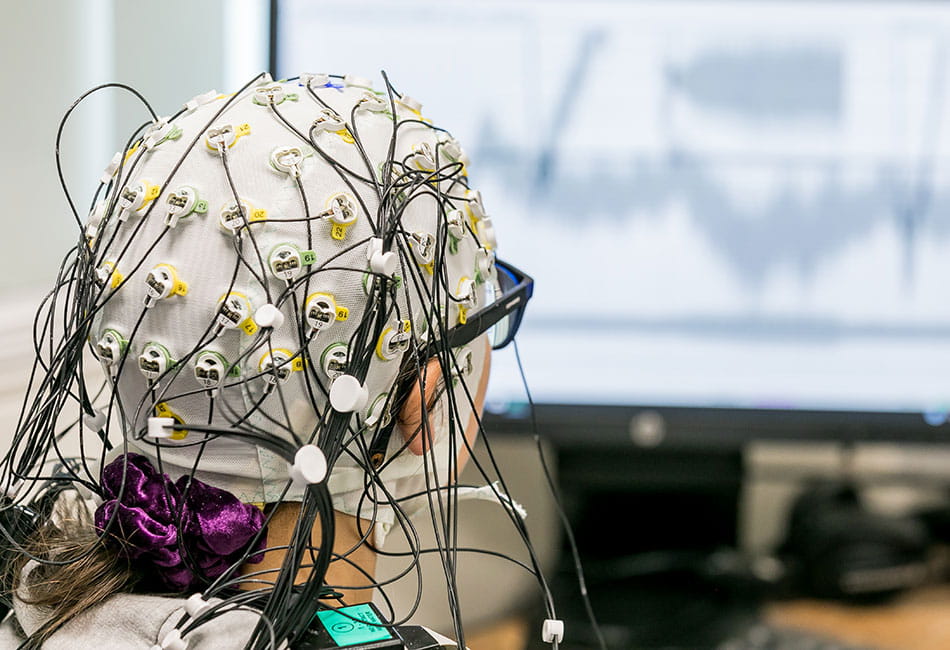
Our specialist psychology labs include Electroencephalography (EEG) labs, a Pain lab, Transcranial Magnetic Stimulation (TMS) lab, Psychology Project rooms and interview rooms that are available to psychology students for their own research. We also have modern computing facilities with qualitative and quantitative statistical and specialist software for psychology.
Carry out psychological experiments, using the latest technology and analytical instrumentation, supported by dedicated psychology technicians.
Investigate perception and eye-movements related to psychological experiences in our eye-tracking labs.
Use our advanced driving simulator to assess the impact of different factors on driving performance and access our health and social care library, one of the largest in the UK.
Our virtual learning environment is a big part of all our courses too. You'll get to engage online with study materials, students and staff, and access blogs, videos, podcasts and discussion boards.
Take a personalised virtual tour of the Psychology, Sociology and Criminology facilities and experience what a typical day could look like here for you.
Personalised virtual tour
There's no need to visit us in person to explore our facilities and campuses. Take a personalised virtual tour and discover it all for yourself from wherever you are.
Take a virtual tourCareers
Careers / Further study
BSc(Hons) Psychology gives you the strong blend of knowledge, skills and experience essential for a career as a chartered psychologist.
As a well-organised, confident communicator, with excellent analytical and critical thinking abilities, you'll also be well suited to careers in healthcare, law enforcement, finance, IT, research, government, education, the creative industries or the legal sector.
Many students also progress to postgraduate study and research degrees.
If you already have a first degree in another subject and are interested in studying Psychology and gaining accreditation from the British Psychological Society (BPS), you may be interested in our MSc Psychology (Conversion) course.
Get inspired
Our award-winning careers service will develop your employment potential through career coaching and find you graduate jobs, placements and global opportunities.
We can also help find local volunteering and community opportunities, provide support for entrepreneurial activity and get you access to employer events.
Visit our employability pages to learn more about careers, employers and what our students are doing six months after graduating.
Life
Accommodation
An excellent range of options for all of the Bristol campuses and the city centre.

Bristol
A stunning city for student living with all the qualities to make you want to stay.

Sports, societies and activities
There is more to your experience here than study. Choose to make the most of it and try new things.

Health and Wellbeing
We provide support in the way you need it.

Campus and facilities
Discover our campuses and the wealth of facilities provided for our students.