BSc(Hons) Computer Science
This course is open for applications.
Accreditations and partnerships:

Study Computer Science in one of Bristol's leading tech hubs and gain skills in AI, software development, and problem-solving. Learn from experts, work on real projects, and access placements with major employers, preparing you for careers from software engineering to AI research.
About
Our Computer Science and Information Management courses are ranked 401-450 in the QS World University Rankings 2026.
Why study computer science?
Computer science is vital to the economy, in the UK and worldwide.
From online retailing, satellite navigation, enterprise software development and intelligent systems, computer-based solutions transform every part of our lives.
The rapid growth of artificial intelligence (AI) means that jobs that didn't even exist a few years ago are being created to meet demand.
It's an exciting and dynamic field offering endless opportunities for skilled graduates to contribute to all aspects of society.
Why UWE Bristol?
BSc(Hons) Computer Science shows you how to analyse complex problems, design algorithms to solve them, and write the programs that put these solutions into practice.
There's a strong AI focus, and you'll learn from experts, studying and applying AI in a range of environments.
You'll develop a solid foundation in enterprise software development and create algorithms that use data structures to manage huge volumes of data. Learn how to design and develop innovative programs ranging from mobile apps to desktop software and large-scale enterprise systems.
Attend talks from professionals and apply your learning through hands-on projects that solve real-world problems.
Bristol is recognised as a high-tech 'super-cluster', with over 30,000 people employed in the industry. You'll be able to work alongside some of them by undertaking a work placement, with companies such as Microsoft, IBM, or GCHQ.
Where can it take me?
After graduating, you could become a software developer, user experience (UX/UI) designer, AI researcher, smart healthcare, database administrator, web developer, Computer Scientist, IoT (Internet of Things) specialist, systems architect, DevOps engineer and more.
Graduates of this Computer Science degree have gone on to work in companies including Hewlett Packard Enterprise (HPE), Rolls Royce, BAE Systems and the Ministry of Defence (MoD).
Welcome to the School of Computing and Creative Technologies at UWE Bristol
Entry
Typical offers
You will need to meet the following Level 2 requirements:
- GCSE: Grade C/4 in English and Mathematics, or equivalent.
In addition to the above Level 2 qualifications, you'll need to achieve the published tariff points from your Level 3 studies prior to entry. Below is an indicative list of the main qualification types. However, we will consider any Level 3 qualifications towards meeting our entry requirements.
- Tariff points: 112
- Contextual tariff: See our contextual offers page.
- English Language Requirement:
International and EU applicants are required to have a minimum overall IELTS (Academic) score of 6.0 with 5.5 in each component (or approved equivalent*).
*The university accepts a large number of UK and International Qualifications in place of IELTS. You can find details of acceptable tests and the required grades you'll need in our English Language section. Please visit our English language requirements page.
- A-level subjects: No specific subjects required.
- BTEC: No specific subjects required.
For information on required Guided Learning Hours please see our minimum entry requirements page.
- Access:
No specific subjects required.
- Baccalaureate IB:
No specific subjects required. We accept the IB Career-related Programme in conjunction with other Level 3 qualifications.
- Irish Highers: No specific subjects required.
- Welsh Baccalaureate: We accept tariff points achieved from the Advanced Skills Baccalaureate Wales in conjunction with other Level 3 qualifications.
- Cambridge Technical: No specific subjects required.
- T Levels: No specific subjects required.
Entry requirements
If you don't meet the entry requirements, you may be eligible for BSc(Hons) Computer Science (with Foundation Year).
International applicants
If you're applying to UWE Bristol from another country or region, visit the international study pages for tailored application information. If you're an international student and don't meet the academic requirements to study this course, you can qualify by completing preparatory study at our International College.
If you're applying to study at UWE Bristol and require additional support to meet our English language requirements, you may be able to attend one of our pre-sessional English courses. Read more about our pre-sessional English Programme.
Read more about entry requirements.
How to apply
Read more about undergraduate applications.
Read more about international applications and key international deadline dates.
For further information
- Email:
UK applicants
Admissions@uwe.ac.ukInternational/EU applicants
International@uwe.ac.uk - Telephone:
UK applicants
+44 (0)117 32 83333International/EU applicants
+44 (0)117 32 86644
Structure
Content
The optional modules listed are those that are most likely to be available, but they may be subject to change.
Year one
You'll focus on the foundational skills and knowledge that you'll use as you progress through the course.
You'll study:
- Foundations of Computer Systems
- Human-Computer Interaction 1
- Artificial Intelligence 1
- Principles of Programming
- Web Development and Databases.
You'll also be introduced to the relationship between computers and systems, and those who use them, along with the core techniques of computer science.
Year two
You'll study:
- Operating Systems and System Security
- Advanced Software Development
- Artificial Intelligence 2
- Systems Development Group Project.
Plus, one optional module from:
- Machine Learning
- Internet of Things.
Placement year (if applicable)
If you study on the four year (sandwich) course, you'll spend a year away from the University on a work placement after year two.
You'll complete a Professional Experience module.
See the Placements and Fees sections for more information.
Final year
You'll study:
- Professional Studies in Computing*
- Digital Systems Project
- Enterprise Software Development.
Plus, two optional modules from:
- Mobile Applications
- Autonomous Agents and Multi-Agent Systems
- Advanced Systems Programming
- Human-Computing Interaction 2
- Advanced Algorithms
- Special Topics in Computer Science
- Advanced Database
- Advanced Artificial Intelligence.
*students who complete a placement year do not take this module.
The University continually enhances our offer by responding to feedback from our students and other stakeholders, ensuring the curriculum is kept up to date and our graduates are equipped with the knowledge and skills they need for the real world. This may result in changes to the course. If changes to your course are approved, we'll inform you.
"My course made me more employable by giving me real-world practical skills in topics such as artificial intelligence. Also, the theory I learned in Software Engineering and Java helped me to land my current role as a Software Engineer at The Hut Group (THG)." Farhad, Computer Science graduate
Learning and Teaching
Our Computer Science degree emphasises practical, applied learning. Teaching is delivered through a mix of lectures, workshops, and lab-based sessions, supported by student-led activities and opportunities for collaboration.
See our full glossary of learning and teaching terms.
Showcase your work
Demonstrate your inventions at our annual degree show.
Past exhibits include a security application that uses facial recognition to track people in a building and an online pinboard for sharing videos, text and other data.
Study time
This is a full-time course designed to balance structured teaching with independent study. You'll attend lectures, workshops, and lab sessions each week, supported by group activities and practical projects. Alongside scheduled contact hours, you're expected to dedicate significant time to independent learning.
Assessment
Your assessment focuses on practical, applied work rather than traditional exams. Most modules use coursework such as coding projects, reports, presentations, and demonstrations. In-class tests may feature occasionally, but the emphasis is on showcasing skills through real-world tasks.
Group projects build collaboration, while individual assignments develop independence. This variety ensures you graduate with experience in delivering solutions, documenting processes, and presenting ideas clearly - skills directly aligned with professional computing practice.
Learn more about assessments.
Fees
Full-time; Sandwich course
Supplementary fee information
Please note, the above tuition fees for home students are charged in the first academic year of study but may increase in subsequent years for both new and continuing students. This increase will track the tuition fee cap which is determined by government and is expected to increase in line with inflation. UWE Bristol will likely maintain its fees for new and returning home students at the maximum permitted level for each year of study.
The placement year fee will also increase when the fee cap changes so please use the above placement year fee for indication purposes only.
Your overall entitlement to funding is based on how long the course is that you're registered on. Standard funding is allocated based on the standard number of years that your course lasts, plus one additional year.
You'll apply for funding each year that you study and Student Finance will take into account how long the course is in each year that you apply. So if you register for the four year course and then transfer to the three year course, the number of years you can apply for funding will change. Student Finance will reassess your funding based on how many years you have been in study, not just those years for which you received student finance.
Always seek advice before taking any action that may have implications for your funding.
Additional costs
This refers to items you could need during your studies that aren't covered by the standard tuition fee. These could be materials, textbooks, travel, clothing, software or printing.
The majority of optional field trips are covered by Faculty funds, however, for high-cost international visits you'll be expected to make a contribution which will vary on a trip-by-trip basis depending on location and duration.
Features
Professional accreditation
We're currently seeking re-accreditation for our BSc(Hons) Computer Science, by the British Computer Society (BCS), the Chartered Institute for IT.
Placements
If you choose to study on the four-year (sandwich) course, you'll spend a year away from the University on a work placement after year two.
You'll complete a placement learning module.
Students who get work experience tend to graduate with better degrees. Experience also hones your skills, industry knowledge and professional network, making you highly employable on graduation.
Our students have worked for companies ranging from dynamic start-ups to medium size organisations like Gamma Telecom and large corporations like Microsoft, IBM and GCHQ.
Placements are varied, with opportunities to work on projects involving data visualisation and analytics; products in the pharmaceutical, chemical, insurance and energy sectors; pure research in areas such as semantic nets; or AI applications in the aerospace industry.
You'll get help to find your placement and support throughout from staff within the School and our award-winning careers service.
Find out more about work experience and placements.
Fieldwork
We arrange field trips to inspire you and help you see computer science applied in industry. Our previous field trips have included:
- A guided tour of Bletchley Park, where Turing and his colleagues helped break Germany's Enigma code during World War 2.
- A visit to CERN in Geneva, where the Higgs Boson was detected for the first time using the Large Hadron Collider and the World Wide Web was invented.
You may also have the chance to attend international conferences held in the UK or abroad, and to visit our partner institutions abroad, meet students and experience learning in different environments and cultures.
Study facilities
Access over 500 workstations in our 24-hour Frenchay Library. Create and test software in Windows and Linux operating systems on our dedicated servers.
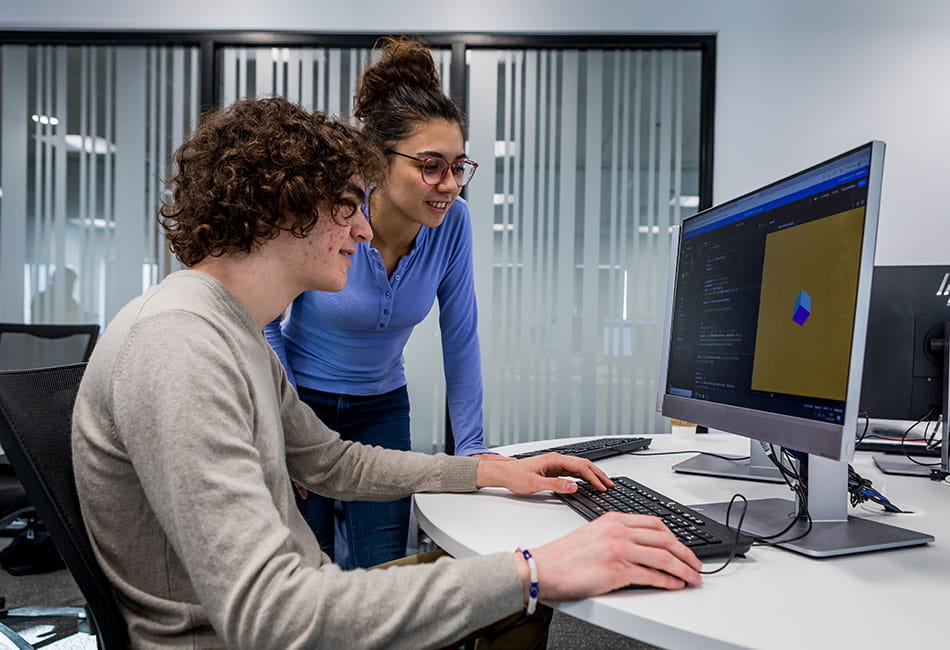
Collaborate with classmates and develop strategies and presentations in our well-equipped computing labs, designed to reflect a real-world development environment.
A mix of traditional and creative learning environments will enable you to learn essential knowledge and real-world skills, preparing you for your professional career.
Learn more about UWE Bristol's facilities and resources.
Take a personalised virtual tour of the Computing facilities and experience what a typical day could look like here for you.
Day in the life tour
Careers
Careers / Further study
By studying our BSc(Hons) Computer Science, you'll take your first step to your chosen career, improve your employability and gain excellent industry links.
UWE Bristol's Computer Science degree blends theoretical computer science with practical software engineering. Our optional modules let you tailor your studies to your interests and career goals, specialising in areas such as human computer interaction (HCI), AI, or software development.
In your final year, you'll have the chance to develop advanced skills in AI including autonomous agents and multi-agent systems, IOT, enterprise development, and database management.
These skills are sought after by employers, so you'll be ready to meet the skills shortage and prepared for a satisfying career in industry or research.
You'll also gain relevant experience in AI through year-long projects. Learn to deliver solutions to practical and ethical issues when applying AI in the real world, transforming people's lives.
We now use digital technologies in every area of life, so you'll find digital jobs across all industries and sectors. Smart devices and connected systems provide a foundation for students to be successful in these fields. Employers will expect future workforces to have a range of abilities across media, technology and digital marketing, to name a few.
You could become a software developer, user experience (UX/UI) designer, AI researcher, smart healthcare developer, database administrator, web developer, Computer Scientist, IoT (Internet of Things) specialist, systems architect, DevOps engineer and more. Previous graduates have gone on to work in companies including HPE, BAE Systems, Rolls Royce, and the MOD.
Get inspired
Our award-winning careers service will develop your employment potential through career coaching and help to find you graduate jobs, placements and global opportunities.
We can also help find local volunteering and community opportunities, provide support for entrepreneurial activity and get you access to employer events.
Visit our employability pages to learn more about careers, employers and what our students are doing six months after graduating.
5 Reasons to Study BSc(Hons) Computer Science at UWE Bristol:
Life

Accommodation
An excellent range of options for all of the Bristol campuses and the city centre.

Bristol
A stunning city for student living with all the qualities to make you want to stay.

Sports, societies and activities
There is more to your experience here than study. Choose to make the most of it and try new things.

Health and Wellbeing
We provide support in the way you need it.

Campus and facilities
Discover our campuses and the wealth of facilities provided for our students.