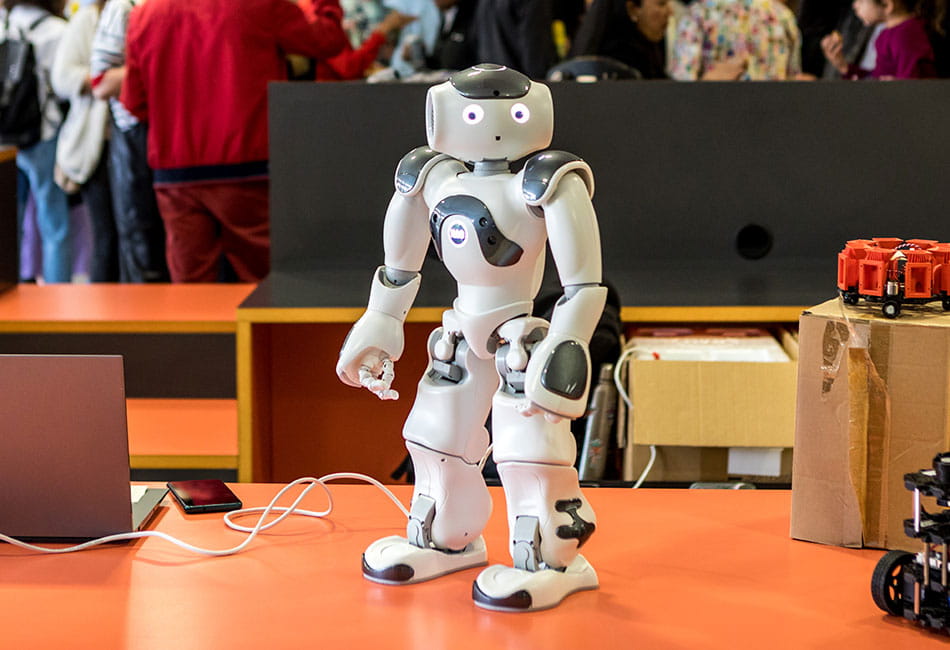
BEng(Hons) Robotics
This course is open for applications
Accreditations and partnerships:
Learn alongside experts from the world-renowned Bristol Robotics Laboratory, using our state-of-the-art equipment to make and test your own inventions.
About
Why study robotics?
Robotics is gradually becoming a part of our daily lives, and we are increasingly relying on intelligent systems to perform routine tasks. Robots are being used in a wide range of applications, from unmanned vehicles in aerospace and sub-sea exploration to consumer products, agriculture, manufacturing, and more. The explosion of interest in artificial intelligence is accelerating the adoption of robotics technology in these sectors and beyond. This makes studying in this field very timely, with a high demand for graduates.
Why UWE Bristol?
This programme draws together state-of-the-art technologies and methodologies with experts in many subfields teaching at the Bristol Robotics Laboratory and the wider School of Engineering.
You'll get experience in robot control, artificial intelligence, computer vision, electronics and more. The integration of knowledge, skills and practice means that you'll learn to tackle real engineering challenges.
This modern engineering curriculum is designed to attract students from diverse backgrounds who are passionate about the future role of robotics engineering in industry and society.
Where can it take me?
As a student engineer, you'll start your professional journey towards becoming an incorporated or chartered engineer from day one. You'll learn by doing, applying and revisiting your early skills through embedded project weeks and development of digital and physical prototypes, just as you would in practice.
There is an increasing demand for graduates with the technical and creative abilities to work in this industry. You'll be prepared for a rewarding career devising, developing and managing intelligent systems in sectors such as manufacturing, aerospace, healthcare, leisure and the creative arts.
Watch: Welcome to the School of Engineering at UWE Bristol
Entry
Typical offers
You will need to meet the following Level 2 requirements:
- GCSE: Grade C/4 in English and Mathematics, or equivalent.
In addition to the above Level 2 qualifications, you'll need to achieve the published tariff points from your Level 3 studies prior to entry. Below is an indicative list of the main qualification types. However, we will consider any Level 3 qualifications towards meeting our entry requirements.
- Tariff points: 112
- Contextual tariff: See our contextual offers page.
- English Language Requirement:
International and EU applicants are required to have a minimum overall IELTS (Academic) score of 6.0 with 5.5 in each component (or approved equivalent*).
*The University accepts a large number of UK and International qualifications in place of IELTS. You can find details of acceptable tests and the required grades you'll need on our English language requirements page.
- A-level subjects: Grade C in Mathematics plus a pass in one of the following subjects: Biology, Chemistry, Computing/Computer Science, Design and Technology, Electronics, Engineering, ICT, Further Maths, Music Technology, Physics, Statistics.
- Relevant subjects: Biology, Chemistry, Computing/Computer Science, Design and Technology, Electronics, Engineering, ICT, Further Maths, Mathematics, Music Technology, Physics, Statistics.
- EDEXCEL (BTEC) Diploma: You must be studying one of the following: Aeronautical Engineering, Construction and the Built Environment, Electrical/Electronic Engineering, Engineering, Land-based Technology, Manufacturing Engineering, Mechanical Engineering, or Operations and Maintenance Engineering.
To include Merit in one of the following units: Further Engineering Mathematics or Further Mathematics for Construction.
Please list the units you are taking in your application. For further advice on acceptable units please email us.
For information on required Guided Learning Hours please see our minimum entry requirements page.
- Access: 15 Level 3 credits at Merit in Mathematics and 15 credits at Pass in another Science or Technology subject.
- Baccalaureate IB: To include a minimum grade of 5 in Higher Level Mathematics and a pass at Higher Level in one of the following subjects: Biology, Chemistry, Computer Science, Design Technology, Physics, Environmental Systems and Societies. We accept the IB Career-related Programme in conjunction with other Level 3 qualifications.
- Irish Highers: H2 in Mathematics plus a pass in one of the following subjects: Biology, Chemistry, Engineering, Physics, Technology.
- Welsh Baccalaureate: We accept tariff points achieved from the Advanced Skills Baccalaureate Wales in conjunction with other Level 3 qualifications. This qualification cannot be used to satisfy any subject specific entry requirements.
- Cambridge Technical: You must be studying one of the following: Mechanical, Electrical and Electronic Systems Design and Engineering; Engineering Automation Control and Manufacturing Processes; Electrical and Electronic Engineering; Mechanical Engineering and Design; Automation, Systems and Control; Manufacturing
To include Merit in the following unit: Applied Mathematics for Engineering. - T Levels: Grade C in A-Level Mathematics, in addition to your T Level qualification. If you have or are looking to partially complete your T-Level, you are still required to have the equivalent to 2 full A-Levels as part of our minimum entry requirements. As a result, if you are applying with only the core or occupational specialism, this may be insufficient as a stand-alone qualification.
Entry requirements
If you don't meet the entry requirements, you may be eligible for BEng(Hons) Robotics (with Foundation Year).
International applicants
If you're applying to UWE Bristol from another country or region, visit the international study pages for tailored application information. If you're an international student and don't meet the academic requirements to study this course, you can qualify by completing preparatory study at our International College.
If you're applying to study at UWE Bristol and require additional support to meet our English language requirements, you may be able to attend one of our pre-sessional English courses. Read more about our pre-sessional English Programme.
Advanced Entry
If you have HNC, HND or FdSc qualifications in closely related subjects, you may be credited with individual modules, which will shorten the course for you.
Please note that applicants are required to achieve all Merits in the Final year of the HND/HNC. If you don't have all Merits in the Final year or have studied a different but closely related subject, we'll consider your application and if we cannot give you Advanced Entry we may be able to credit you with certain modules.
In your application form, please list all the HNC, HND and Foundation Degree units that you have or are taking.
Read more about entry requirements.
How to apply
Read more about undergraduate applications.
Read more about international applications and key international deadline dates.
For further information
- Email:
UK applicants
Admissions@uwe.ac.ukInternational/EU applicants
International@uwe.ac.uk - Telephone:
UK applicants
+44 (0)117 32 83333International/EU applicants
+44 (0)117 32 86644
Structure
Content
You'll study:
Practical Electronics
You'll gain the technical foundation needed for the design of digital and analogue electronic circuits, components and devices. You'll also explore fundamental concepts used in more complex electronic systems.
Professional Skills for Engineers
You'll develop the habits and competencies needed to be a professional engineer, from creative problem-solving to systems thinking. You'll start working towards Engineering Competencies for the UK SPEC EngTech Matrix.
Mathematics for Robotics
You'll develop the knowledge and skills needed to apply mathematical methods to engineering problems. You'll also apply computer-based methodology (including code) to solve mathematical problems and present numerically based information.
Digital and Mechanics Skills
You'll gain a fundamental framework of computer aided design skills and knowledge. You'll also start to explore key mathematical concepts relevant to robotic tasks, vectors and differential equations.
Programming for Engineers
You'll explore the fundamental programming concepts and principles of elementary procedural programming based on the C Programming language.
Fundamental Robotics Principles
You'll cover the fundamentals of robotics, mechatronics and AI, developing your understanding of theories, principles and applications of robotic systems, from mechanical movement to decision making algorithms.
You'll study:
Project Management for Engineers
You'll gain the essential tools and detailed expertise you need to apply project management principles to real-world engineering challenges - from detailed project planning to manage to well-structured engineering research proposals.
Microcontrollers Applications Group Lab
You'll explore concepts and practices relevant to microcontroller-based systems, gaining skills and knowledge in microcontroller programming, embedded systems design, group work, sensor integration, motor control, navigation and algorithm development.
Introduction to Machine Vision
You'll get to grips with state-of-the-art and traditional machine vision concepts and applications, as well as image processing techniques. You'll also explore future directions, from an industry and research perspective.
Signal Theory
You'll develop the fundamental knowledge and skills necessary to solve a range of engineering, electronics and robotics problems which involve signals and signal processing.
Engineering Research
You'll develop your engineering and technology research skills and practice. You'll develop a feasible research proposal that could be implemented as a piece of advanced engineering research and development.
Robot Control Systems
You'll study kinematics and control principles as applied to robots, learning the mechanics and dynamics of robot bodies and how to improve performance by building up feedback control systems.
Optional modules:
Placement year (if applicable)
If you study on the four year sandwich course, you'll spend a year away from the University on a work placement after Year two.
You'll complete a placement learning module.
If you complete the Placement year, you won't study the Final year module Engineering in Society
See the placements and fees sections for more information.
You'll study:
Robot Learning
You'll learn how to assess, develop and apply current machine learning techniques and algorithms to problems in robotic control, and other fields of engineering, to accommodate uncertainty and complexity.
Engineering in Society
You'll explore what it means to be a professional engineer - from the role and wider concepts, to the skills and mindset needed to operate in a modern engineering environment.
Advanced Vision for Localisation and Mapping
You'll gain deep knowledge in advanced robotic visual scene understanding and pose estimation, with a particular focus on state-of-the-art deep learning and computer vision.
Group Design and Integration Project
You'll work in a team on a real engineering challenge from industry or research where an understanding of mechanical and electronic systems principles is essential to create innovative solutions.
Engineering Project
You'll undertake a detailed individual research project, demonstrating substantial engineering subject knowledge, project management skills and awareness of ethical and environmental impact of your work as an engineer.
Optional modules:
You'll study one module from:
- Human Robot Interaction Technologies
- Digital Signal Processing
- Robotic System Architectures.
The optional modules listed are those that are most likely to be available, but they may be subject to change.
If you complete the Placement year, you won't study the Final year module Engineering in Society
The University continually enhances our offer by responding to feedback from our students and other stakeholders, ensuring the curriculum is kept up to date and our graduates are equipped with the knowledge and skills they need for the real world. This may result in changes to the course. If changes to your course are approved, we'll inform you.
"After volunteering on an engineering project, I was offered an internship at Bristol Robotics Lab. I conducted research published in IEEE Xplore and presented at the International Conference of Mechatronic Technology in Singapore, preparing me for my engineering career." Steve, Robotics graduate
Learning and Teaching
We place a strong emphasis on a hands-on approach and you'll start building robots from your very first week at UWE Bristol.
Learn through a mixture of lab sessions, lectures, tutorials and projects. Robotics students are encouraged to support each other and you will easily find somebody to help you understand difficult concepts or learn new skills.
Attend regular sessions where students teach each other. Some students say it's the competition to build the fastest or best-performing robot that drives them to success.
Attend regular presentations from visiting professionals to give you an inside track on the challenges and rewards of the profession.
Showcase work at the annual degree show.
See examples of students' work on YouTube, including Heart Robot.
See our full glossary of learning and teaching terms.
Network and compete
Take part in annual competitions with our Robotics Society.
Volunteer for experience
We encourage you to take on work outside your studies and many students do voluntary work with local artists, businesses and charities.
Past students have won prestigious awards while developing skills teaching robotics in after-school clubs. Others have started businesses around ideas discovered through collaborations.
Assessment
You'll be assessed through a mix of examination and coursework.
Fees
Full-time; Sandwich course
Indicative Additional Costs
Supplementary fee information
Your overall entitlement to funding is based on how long the course is that you're registered on. Standard funding is allocated based on the standard number of years that your course lasts, plus one additional year.
You'll apply for funding each year that you study and Student Finance will take into account how long the course is in each year that you apply. So if you register for the four year course and then transfer to the three year course, the number of years you can apply for funding will change. Student Finance will reassess your funding based on how many years you have been in study, not just those years for which you received student finance.
Always seek advice before taking any action that may have implications for your funding.
Additional costs
This refers to items you could need during your studies that aren't covered by the standard tuition fee. These could be materials, textbooks, travel, clothing, software or printing.
Features
Professional accreditation
This course is accredited by the Institution of Engineering and Technology (IET).
Placements
Students who get work experience tend to graduate with better degrees. Experience also hones your skills, industry knowledge and professional network, making you a sought after graduate.
If you choose the four year (sandwich) course, you'll spend a year away from the University on a work or study placement after Year two.
You'll apply your electronics and artificial intelligence knowledge for global brands or dynamic start-ups across the technology, aerospace, defence and manufacturing sectors.
Past students have done service engineering in microelectronics and developed automation systems for stock trading or productivity.
UWE Bristol students are in high demand, and many have been offered jobs while on placement.
You'll get help to find your placement and support throughout from staff within the School and our award-winning careers service.
Study facilities
Build professional skills and bring inventions to life using our state-of-the-art robotics laboratories and facilities.
Create prototypes in our large open-access lab that includes metalworking machinery, rapid production tools like 3D printers and computer-aided design (CAD) plasma-cutters, oscilloscopes, test equipment and surface-mount soldering systems.
Develop and test software on our dedicated servers with Windows, Linux and Unix based operating systems.
Get technical assistance and advice from our skilled staff from the Bristol Institute of Technology.
A mix of traditional and hands-on learning environments helps you quickly take on essential knowledge and skills, standing you in good stead for your professional career.
Learn more about UWE Bristol's facilities and resources.
Take a personalised virtual tour of the engineering facilities and experience what a typical day could look like here for you.
Personalised virtual tour
There's no need to visit us in person to explore our facilities and campuses. Take a personalised virtual tour and discover it all for yourself from wherever you are.
Take a virtual tourCareers
Careers / Further study
On our BEng(Hons) Robotics, you'll learn about precision control of robots, how software systems and artificial intelligence integrate and how to make complex electronic systems communicate. You'll also discover advanced topics, from machine vision to digital signal processing.
The course will enable you to develop a unique combination of hardware, software and problem-solving skills. You'll also gain core professional skills that you'll take with you through your career, such as innovation, teamwork and creativity.
This blended skillset will make you valuable to employers, and you'll be in demand in a wide range of industries. Many of our graduates are employed by national and global companies, such as UK engineering and software business. Others pursue their creative ambitions by start their own businesses.
Find a job in an artificial intelligence (AI) consultancy on the London Stock Exchange, or develop robots for the world's biggest computer hardware companies. You could also go into research by progressing onto MSc Robotics, or studying a PhD at Bristol Robotics Laboratory.
Throughout your course, you'll benefit from many practical professional opportunities. Take part in European robotics competitions, where our students have excelled in the past, or design and build your own mobile robot to compete against your classmates.
You'll also have the chance to complete work placements with blue-chip organisations such as Intel, the London Stock Exchange and IBM, or dynamic start-ups or challenger brands.
If you have entrepreneurial aspirations, you could set up your own business based on your inventions, shaping how this new technology impacts societies in the future.
For example, see the Sentry Robot, which senses and shoots moving targets, and the Robot Spider, which uses inverse kinematics to create natural movement both built by our students.
Get inspired
Our award-winning careers service will develop your employment potential through career coaching and find you graduate jobs, placements and global opportunities.
We can also help find local volunteering and community opportunities, provide support for entrepreneurial activity and get you access to employer events.
Visit our employability pages to learn more about careers, employers and what our students are doing six months after graduating.
Take a look at the Engineering building
Step inside our new School of Engineering building at UWE Bristol.
Life
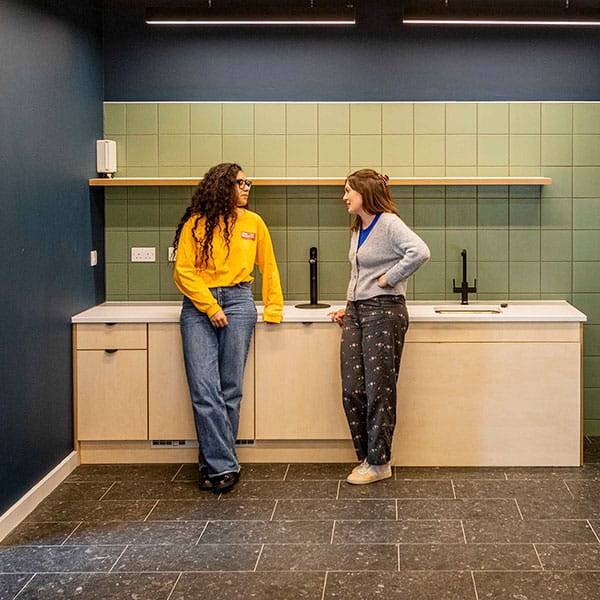
Accommodation
An excellent range of options for all of the Bristol campuses and the city centre.

Bristol
A stunning city for student living with all the qualities to make you want to stay.

Sports, societies and activities
There is more to your experience here than study. Choose to make the most of it and try new things.

Health and Wellbeing
We provide support in the way you need it.
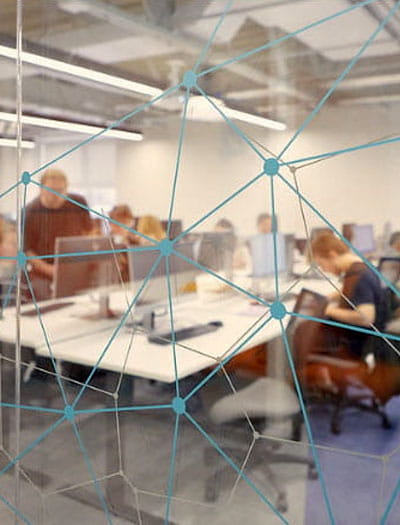
Campus and facilities
Discover our campuses and the wealth of facilities provided for our students.