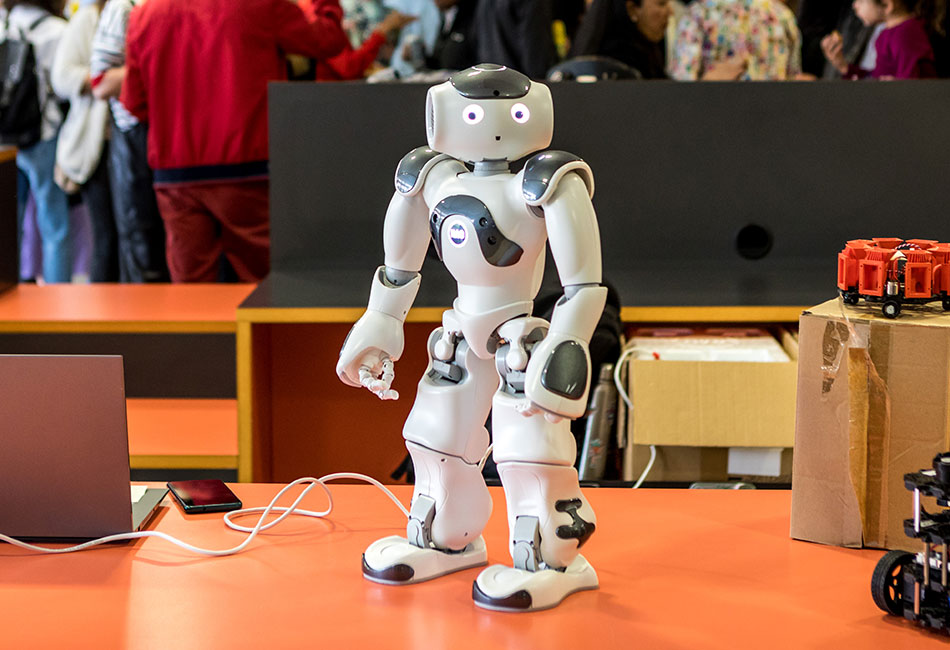
BEng(Hons) Robotics (with Foundation Year)
This course is open for applications
Accreditations and partnerships:
Get on track for our BEng(Hons) Robotics degree by completing a foundation year - if you're committed to an engineering future and have a less conventional background, this is the course for you.
About
Why study robotics?
Embedded intelligence features in products ranging from cars to domestic appliances.
Intelligent systems range from unmanned vehicles in aerospace and robots in sub-sea exploration, to consumer products and the creative arts.
In the future, robots will be part of our everyday lives, helping in areas such as healthcare, education and entertainment.
Industry forecasters predict that the service robot market will increase in value to an annual 66 billion by 2025. Demand for graduates with the technical and creative ability to work in this area is set to increase too.
Why UWE Bristol?
BEng(Hons) Robotics is taught by world-class researchers from one of Europe's largest robotics labs.
This degree is for anyone interested in understanding and developing robots. Although this is primarily an engineering course, it extends into areas like artificial life, biology-inspired robotics, swarm intelligence and human-robot interaction.
Gain plenty of hands-on experience building and testing your inventions, using our state-of-the-art equipment and facilities.
Develop a unique combination of hardware, software and problem solving skills. Design and build your own mobile robot to compete against your classmates.
Learn about precision control of robots, how software systems and artificial intelligence integrate and how to make complex electronic systems communicate.
Discover advanced topics such as machine vision, how to make robots learn to control themselves and digital signal processing.
Take part in European robotics competitions, where our students have excelled in the past. Complete work placements with blue-chip organisations such as Intel, the London Stock Exchange and IBM, or dynamic start-ups or challenger brands.
Where can it take me?
The blend of hardware, software and problem solving skills you acquire on this course make you valuable to a wide range of industries.
You'll be set for a rewarding career devising, developing and managing intelligent systems in sectors such as manufacturing, aerospace, healthcare, leisure and the creative arts.
Set up your own business based on your inventions andplay a role in defining how this new technology will impact societies in the future.
See the Sentry Robot, which senses and shoots moving targets, and the Robot Spider, which uses inverse kinematics to create natural movement both built by our students.
Watch: Welcome to the School of Engineering at UWE Bristol
Entry
Typical offers
You will need to meet the following Level 2 requirements:
- GCSE: Grade C/4 in English and Mathematics, or equivalent.
In addition to the above Level 2 qualifications, you'll need to achieve the published tariff points from your Level 3 studies prior to entry. Below is an indicative list of the main qualification types. However, we will consider any Level 3 qualifications towards meeting our entry requirements.
- Tariff points: 80
- Contextual tariff: See our contextual offers page.
- English Language Requirement:
International and EU applicants are required to have a minimum overall IELTS (Academic) score of 6.0 with 5.5 in each component (or approved equivalent*).
*The university accepts a large number of UK and International Qualifications in place of IELTS. You can find details of acceptable tests and the required grades you will need in our English Language section. Please visit our English language requirements page. - A-level subjects: No specific subjects required.
- EDEXCEL (BTEC) Diploma: No specific subjects required. For information on required Guided Learning Hours please see our minimum entry requirements page.
- Access: No specific subjects required.
- Baccalaureate IB: No specific subjects required. We accept the IB Career-related Programme in conjunction with other Level 3 qualifications.
- Irish Highers: No specific subjects required.
- Welsh Baccalaureate: We accept tariff points achieved from the Advanced Skills Baccalaureate Wales in conjunction with other Level 3 qualifications.
- Cambridge Technical: No specific subjects required.
- T Levels: No specific subjects required.
Entry requirements
If you exceed the entry requirements you may be eligible for BEng(Hons) Robotics.
International applicants
If you are an international student your recommended route of study for this degree is through our International College, which upon successful completion to the required level and with good attendance, guarantees entry to Year one of the degree.
Read more about entry requirements.
How to apply
Read more about undergraduate applications.
For further information
- Email:
UK applicants
Admissions@uwe.ac.ukInternational/EU applicants
International@uwe.ac.uk - Telephone:
UK applicants
+44 (0)117 32 83333International/EU applicants
+44 (0)117 32 86644
Structure
Content
You'll study:
Foundation Mechanics
You'll focus on building your knowledge and skills in statics, dynamics, fluid dynamics and the required mathematics for those areas of mechanics, giving you the confidence to progress to the next year of study.
Foundation Mathematics: Algebra and Calculus
You'll cover foundational Numerical, Algebraic and Calculus methods so that you feel confident when approaching material at higher levels and developing your appreciation for mathematics as a driving force for problem-solving.
Introduction to Mechatronics
This module will give you hands-on experience of working with electrical elements, sensors and the fundamentals of digital electronics, building your awareness of how individual components work together to perform more complex tasks.
Engineering Experimentation
You'll be equipped with the skills to safely conduct experiments, collect and analyse data, and draw meaningful conclusions. You'll learn to minimise risk in experimental settings and how to accurately record observations and results.
Foundation Group Project
You'll study the theory, application and simulation/optimisation of engineering problems, working in groups to develop research, modelling, problem solving and investigation skills.
You'll study:
Practical Electronics
You'll gain the technical foundation needed for the design of digital and analogue electronic circuits, components and devices. You'll also explore fundamental concepts used in more complex electronic systems.
Professional Skills for Engineers
You'll develop the habits and competencies needed to be a professional engineer, from creative problem-solving to systems thinking. You'll start working towards Engineering Competencies for the UK SPEC EngTech Matrix.
Mathematics for Robotics
You'll develop the knowledge and skills needed to apply mathematical methods to engineering problems. You'll also apply computer-based methodology (including code) to solve mathematical problems and present numerically based information.
Digital and Mechanics Skills
You'll gain a fundamental framework of computer aided design skills and knowledge. You'll also start to explore key mathematical concepts relevant to robotic tasks, vectors and differential equations.
Programming for Engineers
You'll explore the fundamental programming concepts and principles of elementary procedural programming based on the C Programming language.
Fundamental Robotics Principles
You'll cover the fundamentals of robotics, mechatronics and AI, developing your understanding of theories, principles and applications of robotic systems, from mechanical movement to decision making algorithms.
You'll study:
Project Management for Engineers
You'll gain the essential tools and detailed expertise you need to apply project management principles to real-world engineering challenges - from detailed project planning to manage to well-structured engineering research proposals.
Microcontrollers Applications Group Lab
You'll explore concepts and practices relevant to microcontroller-based systems, gaining skills and knowledge in microcontroller programming, embedded systems design, group work, sensor integration, motor control, navigation and algorithm development.
Introduction to Machine Vision
You'll get to grips with state-of-the-art and traditional machine vision concepts and applications, as well as image processing techniques. You'll also explore future directions, from an industry and research perspective.
Signal Theory
You'll develop the fundamental knowledge and skills necessary to solve a range of engineering, electronics and robotics problems which involve signals and signal processing.
Engineering Research
You'll develop your engineering and technology research skills and practice. You'll develop a feasible research proposal that could be implemented as a piece of advanced engineering research and development.
Robot Control Systems
You'll study kinematics and control principles as applied to robots, learning the mechanics and dynamics of robot bodies and how to improve performance by building up feedback control systems.
Optional modules:
Placement year (if applicable)
If you study on the four year sandwich course, you'll spend a year away from the University on a work placement after Year two.
You'll complete a placement learning module.
See the placements and fees sections for more information.
You'll study:
Robot Learning
You'll learn how to assess, develop and apply current machine learning techniques and algorithms to problems in robotic control, and other fields of engineering, to accommodate uncertainty and complexity.
Engineering in Society
You'll explore what it means to be a professional engineer - from the role and wider concepts, to the skills and mindset needed to operate in a modern engineering environment.
Advanced Vision for Localisation and Mapping
You'll gain deep knowledge in advanced robotic visual scene understanding and pose estimation, with a particular focus on state-of-the-art deep learning and computer vision.
Group Design and Integration Project
You'll work in a team on a real engineering challenge from industry or research where an understanding of mechanical and electronic systems principles is essential to create innovative solutions.
Engineering Project
You'll undertake a detailed individual research project, demonstrating substantial engineering subject knowledge, project management skills and awareness of ethical and environmental impact of your work as an engineer.
Optional modules:
You'll study one module from:
- Human Robot Interaction Technologies
- Digital Signal Processing
- Robotic System Architectures.
The optional modules listed are those that are most likely to be available, but they may be subject to change.
You normally need to pass your foundation year before going into year one.
The University continually enhances our offer by responding to feedback from our students and other stakeholders, ensuring the curriculum is kept up to date and our graduates are equipped with the knowledge and skills they need for the real world. This may result in changes to the course. If changes to your course are approved, we'll inform you.
Learning and Teaching
We place a strong emphasis on a hands-on approach and you'll start building robots from your very first week at UWE Bristol.
Learn through a mixture of lab sessions, lectures, tutorials and projects. Robotics students are encouraged to support each other and you will easily find somebody to help you understand difficult concepts or learn new skills.
Attend regular sessions where students teach each other. Some students say it's the competition to build the fastest or best-performing robot that drives them to success.
Attend regular presentations from visiting professionals to give you an inside track on the challenges and rewards of the profession.
Showcase work at the annual Environment and Technology Degree Show.
See examples of students' work on YouTube, including Heart Robot.
See our full glossary of learning and teaching terms.
Network and compete
Take part in annual competitions with our Robotics Society.
Volunteer for experience
We encourage you to take on work outside your studies and many students do voluntary work with local artists, businesses and charities.
Past students have won prestigious awards while developing skills teaching robotics in after-school clubs. Others have started businesses around ideas discovered through collaborations.
Assessment
You'll be assessed through a mix of examination and coursework.
Fees
Full-time; Sandwich course
Supplementary fee information
Please note, the above tuition fees for home students are charged in the first academic year of study but may increase in subsequent years for both new and continuing students. This increase will track the tuition fee cap which is determined by government and is expected to increase in line with inflation. UWE will likely maintain its fees for new and returning home students at the maximum permitted level for each year of study.
The placement year fee will also increase when the fee cap changes so please use the above placement year fee for indication purposes only.
Your overall entitlement to funding is based on how long the course is that you're registered on. Standard funding is allocated based on the standard number of years that your course lasts, plus one additional year.
You'll apply for funding each year that you study and Student Finance will take into account how long the course is in each year that you apply. So if you register for the five year course and then transfer to the four year course, the number of years you can apply for funding will change. Student Finance will reassess your funding based on how many years you have been in study, not just those years for which you received student finance.
Always seek advice before taking any action that may have implications for your funding.
Additional costs
Additional costs are for items you could need during your studies that aren't covered by the standard tuition fee. These could be materials, textbooks, travel, clothing, software or printing.
Features
Professional accreditation
This course is accredited by the Institution of Engineering and Technology (IET).
Placements
Students who get work experience tend to graduate with better degrees. Experience also hones your skills, industry knowledge and professional network, making you a sought after graduate.
If you choose the five year (sandwich) course, you'll spend a year away from the University on a work placement after Year two.
You'll apply your electronics and artificial intelligence knowledge for global brands or dynamic start-ups across the technology, aerospace, defence and manufacturing sectors.
Past students have done service engineering in microelectronics and developed automation systems for stock trading or productivity.
UWE Bristol students are in high demand, and many have been offered jobs while on placement.
Get help to find your placement and support throughout from staff within the school and our award-winning careers service.
Study facilities
Build professional skills and bring inventions to life using our state-of-the-art robotics laboratories and facilities.
Create prototypes in our large open-access lab that includes metalworking machinery, rapid production tools like 3D printers and computer-aided design (CAD) plasma-cutters, oscilloscopes, test equipment and surface-mount soldering systems.
Develop and test software on our dedicated servers with Windows, Linux and Unix based operating systems.
Get technical assistance and advice from our skilled staff from the Bristol Institute of Technology.
A mix of traditional and hands-on learning environments helps you quickly take on essential knowledge and skills, standing you in good stead for your professional career.
Take a personalised virtual tour of the Engineering facilities and experience what a typical day could look like here for you.
Personalised virtual tour
There's no need to visit us in person to explore our facilities and campuses. Take a personalised virtual tour and discover it all for yourself from wherever you are.
Take a virtual tourCareers
Careers / Further study
Our graduates are in demand and work in a range of areas.
They work in artificial intelligence (AI) consultancy on the London Stock Exchange and developing robots for the world's biggest computer hardware companies. They use their skills within UK engineering and software businesses.
Our graduates have been offered jobs with national and global companies, while others started their own businesses and are pursuing their creative ambitions.
You could also go into research by progressing onto MSc Robotics or studying a PhD at Bristol Robotics Laboratory.
Get inspired
Our award-winning careers service will develop your employment potential through career coaching and find you graduate jobs, placements and global opportunities.
We can also help find local volunteering and community opportunities, provide support for entrepreneurial activity and get you access to employer events.
Visit our employability pages to learn more about careers, employers and what our students are doing six months after graduating.
Take a look at the Engineering building
Step inside our new School of Engineering building at UWE Bristol.
Life
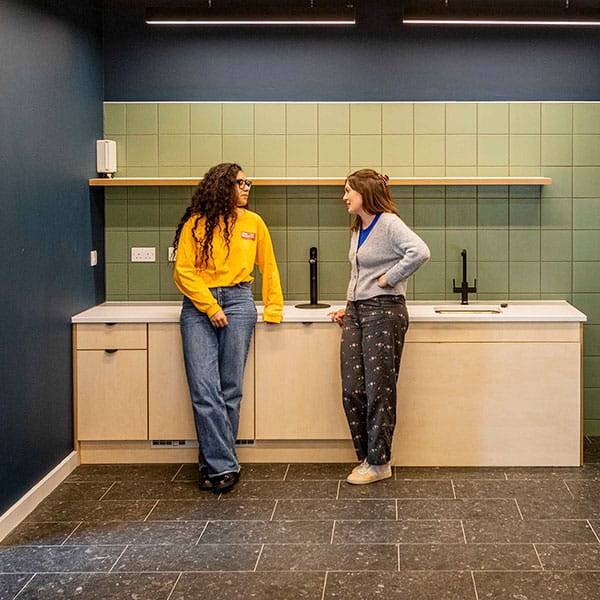
Accommodation
An excellent range of options for all of the Bristol campuses and the city centre.

Bristol
A stunning city for student living with all the qualities to make you want to stay.

Sports, societies and activities
There is more to your experience here than study. Choose to make the most of it and try new things.

Health and Wellbeing
We provide support in the way you need it.
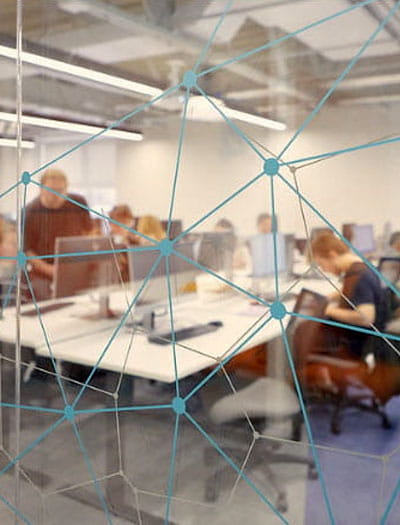
Campus and facilities
Discover our campuses and the wealth of facilities provided for our students.