BSc(Hons) Biomedical Science
This course is open for applications
Accreditations and partnerships:

Accredited by the Institute of Biomedical Science, BSc(Hons) Biomedical Science provides strong practical skills in the biomedical sciences field, with the option to gain a year's work experience with a leading employer in the UK or abroad.
About
Why study biomedical science?
Have you ever wondered how genetic mutations occur, how the body metabolises proteins, or how white blood cells fight infections? Perhaps you've wished you could help understand how diseases develop and find ways to treat them?
To diagnose and treat diseases effectively, we need to understand the biology behind them, the science that supports this understanding, and the latest advances in medical research.
BSc(Hons) Biomedical Science focusses on human health and disease and pulls together clinical science and research, both important parts of the diagnostic and treatment process.
Why UWE Bristol?
BSc(Hons) Biomedical Science provides a hands-on learning experience. You'll gain broad knowledge across various biomedical science disciplines and have the chance to tailor your learning by focusing on areas that interest you the most.
Gain a strong grounding in modern biomedicine, studying core scientific subjects and the biology of disease alongside specialist biomedical topics.
Work at the cutting edge of biomedical science using highly specialised equipment and build essential practical experience through placements, internships and volunteering.
If you're successful in securing a placement, you could spend your third year working with an employer or at another university in the pharmaceutical, healthcare, research, or wider sector. This could be in the UK, Europe, or further afield.
With a strong focus on the application of science in the real world, this course is excellent preparation for a range of science careers.
What can I do with a biomedical science degree?
You'll have the opportunity to pursue a variety of careers, including roles such as registered clinical biomedical scientist or in research and development within the healthcare and pharmaceutical sectors. You could secure a career in sales, media, or education, or continue studying at postgraduate level.
A biomedical science degree from UWE Bristol can lead to HCPC registration and Band 5 Biomedical Scientist roles in the NHS, either through successful completion of one of our competitive NHS sandwich placements during your degree (which includes the IBMS portfolio), or by completing the portfolio after graduation in a trainee role.
Watch: Welcome to the School of Applied Sciences at UWE Bristol
Entry
Typical offers
You will need to meet the following Level 2 requirements:
- GCSE: Grade C/4 or above in English, Mathematics and Double Science, or equivalent.
In addition to the above Level 2 qualifications, you'll need to achieve the published tariff points from your Level 3 studies prior to entry. Below is an indicative list of the main qualification types. However, we will consider any Level 3 qualifications towards meeting our entry requirements.
- Tariff points: 120
- Contextual tariff: See our contextual offers page.
- English Language Requirement:
International and EU applicants are required to have a minimum overall IELTS (Academic) score of 6.0 with 5.5 in each component (or approved equivalent*).
*The University accepts a large number of UK and International Qualifications in place of IELTS. You can find details of acceptable tests and the required grades you'll need in our English Language section. Please visit our English language requirements page. - A-level subjects: Grade B in Biology or Chemistry.
- EDEXCEL (BTEC) Diploma: Six units in Biology or Chemistry. Please list the units you're studying in your application. For further advice on acceptable units, please email Admissions. For information on required Guided Learning Hours please see our minimum entry requirements page.
- Access: 15 Level 3 credits at Distinction in Biology or Chemistry.
- Baccalaureate IB: A minimum Grade 6 in Higher Level Biology or Chemistry. We accept the IB Career-related Programme in conjunction with other Level 3 qualifications.
- Irish Highers: H2 in Biology or Chemistry.
- Welsh Baccalaureate: We accept tariff points achieved from the Advanced Skills Baccalaureate Wales in conjunction with other Level 3 qualifications. This qualification cannot be used to satisfy any subject specific entry requirements.
- Cambridge Technical: You'll need a minimum of five units in Biology or Chemistry. You may be asked to do more based on the size of your units. Please list the units you are studying in your application. For further advice on acceptable units, please email us. For information on required Guided Learning Hours please see our minimum entry requirements page.
- T Levels: Science or Healthcare Science. If you partially achieve your T Level, you can meet our subject requirements if you have at least a C in your Core Section. For further advice on acceptable subjects please email us.
Entry requirements
If you don't meet the entry requirements, you may be eligible for BSc(Hons) Biomedical Science (with Foundation Year).
International applicants
If you're applying to UWE Bristol from another country or region, visit the international study pages for tailored application information. If you're an international student and don't meet the academic requirements to study this course, you can qualify by completing preparatory study at our International College.
If you're applying to study at UWE Bristol and require additional support to meet our English language requirements, you may be able to attend one of our pre-sessional English courses. Read more about our pre-sessional English Programme.
Read more about entry requirements.
How to apply
Read more about undergraduate applications.
Read more about international applications and key international deadline dates.
For further information
- Email:
UK applicants
Admissions@uwe.ac.ukInternational/EU applicants
International@uwe.ac.uk - Telephone:
UK applicants
+44 (0)117 32 83333International/EU applicants
+44 (0)117 32 86644
Structure
Content
You'll study:
Human Anatomy and Physiology
You'll explore the structure and function of the human body across all major body systems, including support and visceral systems plus mechanisms of action and homeostasis.
Cells, Biochemistry and Genetics
You'll explore molecular cell biology, considering what cells are made of, how they function and reproduce, and how we study them.
Biomedical Skills
You'll be prepared for analytical and professional problem solving, and develop the practical skills you will require as practising biomedical scientists in the NHS or wider biomedical related fields of work.
Infection and Disease
You'll learn about the key disciplines within Biomedical Science and the mechanisms and diagnosis of a range of diseases, along with the body's response to disease. The latest issues in microbiological public health will also be discussed.
You'll study:
Molecular Cell Biology
You'll be equipped with essential laboratory techniques, key molecular techniques, endpoint PCR, and DNA sequencing. You'll also develop skills that help you to study and analyse human chromosomes and DNA.
Applied Scientific Practice
Through case study-based practicals, you'll gain essential knowledge on the scientific method, its use and application including how experiments are designed and performed, how data is analysed and communicated.
Studies in the Biology of Disease
On this module you'll study the pathophysiology responsible for disease and disorders in the human body including investigation and diagnosis of selected diseases.
Optional modules:
You'll choose modules (the number depending on credit requirements) from:
- Blood Science
- Cell Signalling
- Human Physiology
- Immunology
- Medicinal Chemistry
- Microbial Pathogenesis
- Molecular Genetics
- Pharmacology
- Tissue and Tumour Science.
Placement year (if applicable)
If you study on the four year (sandwich) course, you'll spend a year away from the University on a work placement after year two.
You'll also study the Professional Practice in Applied Sciences module.
See the Placements and Fees sections for more information.
You'll study:
Research Dissertation Project
You'll undertake an independent research project under the guidance of an academic supervisor, developing your skills and knowledge in contemporary scientific research.
Optional modules:
You'll choose one or more modules (depending on credit requirements) from:
- Haematology and Transfusion Science
- Clinical Biochemistry
- Medical Microbiology
- Applied Immunology
- Medical Genetics
- Cellular Pathology and Oncology.
Plus, modules (the amount depending on credit requirements) from:
- Antimicrobial Agents
- Pharmacology and Toxicology
- Pathophysiology
- Physical Activity, Nutrition and Health
- Neuroscience and Neuropharmacology
- Developmental and Stem Cell Science
- Medical Technology and Enterprise
- Genomic Technologies.
The optional modules listed are those that are most likely to be available, but they may be subject to change.
This structure is for full-time students only. Part-time students study the same modules but the delivery pattern will be different.
The University continually enhances our offer by responding to feedback from our students and other stakeholders, ensuring the curriculum is kept up to date and our graduates are equipped with the knowledge and skills they need for the real world. This may result in changes to the course. If changes to your course are approved, we'll inform you.
Learning and Teaching
We take a student-centred approach to learning. You'll get one-to-one guidance and individual feedback, and we'll encourage you to learn independently through lectures, seminars, and tutorials.
You'll deepen your understanding and skills in practical classes, labs, computer-based sessions, and our virtual learning environment. Our research-informed teaching covers modern biomedicine, experimental design, and data handling.
Your practical learning will culminate in an independent research project in your final year, supervised by a project supervisor and possibly their research team. You'll work with tutors who are leading biomedical science specialists, supporting your development as a biomedical scientist.
Throughout the course, you'll collaborate closely with your peers and receive support from student advisers and a year tutor.
See our full glossary of learning and teaching terms.
Assessment
We'll assess your understanding and skills using a variety of assessment tools including essays, reports, group tasks, and presentations. Overall, it'll be a mix of coursework and exams.
Learn more about assessments.
Fees
Full-time; Sandwich course
Indicative Additional Costs
Supplementary fee information
Your overall entitlement to funding is based on how long the course is that you're registered on. Standard funding is allocated based on the standard number of years that your course lasts, plus one additional year.
You'll apply for funding each year that you study and Student Finance will take into account how long the course is in each year that you apply. So if you register for the four year course and then transfer to the three year course, the number of years you can apply for funding will change. Student Finance will reassess your funding based on how many years you have been in study, not just those years for which you received student finance.
Always seek advice before taking any action that may have implications for your funding.
Additional costs
Additional costs are for items you could need during your studies that aren't covered by the standard tuition fee. These could be materials, textbooks, travel, clothing, software or printing.
Features
Professional accreditation
The course is accredited by the Institute of Biomedical Science (IBMS), the professional body responsible for ensuring that biomedical science degrees meet the rigorous academic and professional standards required for graduates to become practising NHS Biomedical Scientists.
Placements
Work experience can lead to higher degrees and a smoother transition into employment or further studies. It also enhances skills, industry knowledge, and professional networks, making you a highly sought-after graduate.
We have links with many employers, including the NHS, GlaxoSmithKline, Novartis, ICI, government laboratories including CAMR and Porton Down, and university research centres.
If you secure a placement advertised or supported by UWE Bristol, or find one independently that the University approves, you'll undertake up to 40 weeks of work-based training in a specialised area of biomedical science.
You'll get help to find a placement and support throughout from staff within the School and our award-winning careers service.
Study facilities
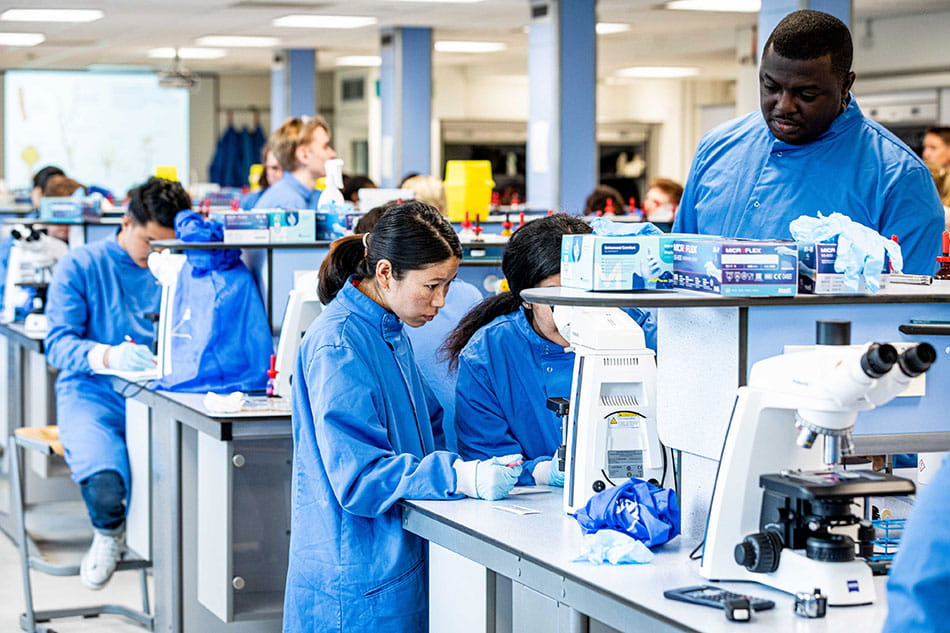
Benefit from our well-equipped, modern science laboratories, with specialist apparatus for histology, haematology and biochemistry, molecular biology and cell culture.
Use the latest instrumentation to measure human performance physiology.
Carry out research projects using our extensive facilities for light-based microscopy (including confocal and fluorescent) and an electron microscopy suite.
Learn more about UWE Bristol'sfacilities and resources.
Take a personalised virtual tour of the Biosciences facilities and experience what a typical day could look like here for you.
Personalised virtual tour
There's no need to visit us in person to explore our facilities and campuses. Take a personalised virtual tour and discover it all for yourself from wherever you are.
Take a virtual tourCareers
Careers / Further study
You'll graduate with the insight, tools and practical experience to make a valuable contribution to the health of the community.
Graduates may go on to become biomedical scientists in the NHS by also completing the IBMS Registration Portfolio and gaining HCPC registration. Many also pursue careers in biomedical sciences, especially in research and development within the healthcare, pharmaceutical, and education sectors.
As well as preparing you for a laboratory-based job, the course will give you the transferable skills employers value in a wide variety of roles, from medical sales and scientific writing to quality control and health and safety.
Some graduates use their qualification to successfully apply for mature entry to medicine degrees, while others continue with MPhil/PhD research degrees or masters' courses.
As a graduate, you'll be eligible to apply for a range of postgraduate courses at UWE Bristol, which will give you advanced knowledge and support your career development. These include MSc Biomedical Science, MSc Forensic Science, MSc Applied Transfusion and Transplantation Science, MRes Applied Sciences, MSc Sustainable Food Systems, MSc Health Technology and MSc Science Communication.
Get inspired
Our award-winning careers service will develop your employment potential through career coaching and find you graduate jobs, placements and global opportunities.
We can also help find local volunteering and community opportunities, provide support for entrepreneurial activity and get you access to employer events.
Visit our employability pages to learn more about careers, employers and what our students are doing six months after graduating.
See also:
Watch: How to be a... bare-knuckle boxer
Life

Accommodation
An excellent range of options for all of the Bristol campuses and the city centre.

Bristol
A stunning city for student living with all the qualities to make you want to stay.

Sports, societies and activities
There is more to your experience here than study. Choose to make the most of it and try new things.

Health and Wellbeing
We provide support in the way you need it.

Campus and facilities
Discover our campuses and the wealth of facilities provided for our students.