BEng(Hons) Automotive Engineering (with Foundation Year)
This course is open for applications
Accreditations and partnerships:


Get on track for our IMechE accredited BEng(Hons) Automotive Engineering degree, by completing a foundation year. If you're committed to an engineering future and have a less conventional background, this is the course for you.
About
Why study automotive engineering?
The automotive industry is set for global growth over the next decade.
Environmental challenges mean new vehicles must be cleaner and more efficient, while urbanisation is driving a need for better transport solutions.
This will create demand for professionals with knowledge and skills in automotive design and manufacture. And if you're always asking questions, exploring different alternatives, and thinking creatively then you're just who we're looking for.
Why UWE Bristol?
BEng(Hons) Automotive Engineering gives you a strong grounding in mathematics, design, manufacturing and mechanical engineering.
Discover how engineering will challenge you and change the way you learn. You'll tackle real world issues through live projects, and be encouraged to take risks as you develop solutions in our state-of-the art labs.
Study automotive manufacturing, engine systems, vehicle dynamics, materials, structures and safety. Gain hands-on experience, testing designs for automotive projects using our facilities.
You'll be taught in our new state-of-the-art School of Engineering designed to revolutionise the way engineering is taught. Featuring engine test cells, dedicated collaborative learning spaces and all of the latest high-tech equipment, it's purpose-built to support a wide range of engineering disciplines.
Investigate an engineering problem that interests you, while developing engineering, project management and report writing skills.
Complete work placements in areas like product development, vehicle dynamics and design, and manufacturing. Compete with our multi-disciplinary team UWE Formula Student, which regularly succeeds at the annual Formula Student competition.
With opportunities at some of the biggest names in engineering on your doorstep, you'll be able to increase your employability and find the engineer you are.
Where can it take me?
Careers range from automotive design to manufacture and maintenance. You could help research the next wave of green and sustainable transport technologies.
Watch: Welcome to the School of Engineering at UWE Bristol
Entry
Typical offers
You will need to meet the following Level 2 requirements:
- GCSE: Grade C/4 in English and Mathematics, or equivalent.
Level 3
In addition to the above Level 2 qualifications, you'll need to achieve the published tariff points from your Level 3 studies prior to entry. Below is an indicative list of the main qualification types. However, we will consider any Level 3 qualifications towards meeting our entry requirements.
- Tariff points: 72
- Contextual tariff: See our contextual offers page.
- A-Levels: No specific subjects required.
- T Levels:
No specific subjects required.
- BTEC:
No specific subjects required. For information on required Guided Learning Hours please see our minimum entry requirements page.
- Access:
No specific subjects required.
- International Baccalaureate:
No specific subjects required. We accept the IB Career-related Programme in conjunction with other Level 3 qualifications.
- Cambridge Technical: No specific subjects required.
- Irish Highers: No specific subjects required.
- Welsh Baccalaureate: We accept tariff points achieved from the Advanced Skills Baccalaureate Wales in conjunction with other Level 3 qualifications.
- English Language Requirement:
International and EU applicants are required to have a minimum overall IELTS (Academic) score of 6.0 with 5.5 in each component (or approved equivalent*).
*The University accepts a large number of UK and International Qualifications in place of IELTS. You can find details of acceptable tests and the required grades you will need in our English Language section. Please visit our English language requirements page.
Entry requirements
If you exceed the entry requirements you may be eligible for BEng(Hons) Automotive Engineering.
International applicants
If you are an international student your recommended route of study for this degree is through our international college, which upon successful completion to the required level and with good attendance, guarantees entry to year one of the degree.
Read more about entry requirements.
How to apply
Read more about undergraduate applications.
For further information
- Email:
UK applicants
Admissions@uwe.ac.ukInternational/EU applicants
International@uwe.ac.uk - Telephone:
UK applicants
+44 (0)117 32 83333International/EU applicants
+44 (0)117 32 86644
Structure
Content
You'll study:
Foundation Mechanics
You'll focus on building your knowledge and skills in statics, dynamics, fluid dynamics and the required mathematics for those areas of mechanics, giving you the confidence to progress to the next year of study.
Foundation Mathematics: Algebra and Calculus
You'll cover foundational Numerical, Algebraic and Calculus methods so that you feel confident when approaching material at higher levels and developing your appreciation for mathematics as a driving force for problem-solving.
Introduction to Mechatronics
Through hands-on activities, this module will introduce you to mechatronic systems and show how mechanical, electrical and digital components work together. You'll explore bearings, gears, transmission systems and pneumatic actuators alongside switches, motors, relays, pumps, sensors, solenoids, current, voltage, resistors, capacitors and inductors. Sensing topics will include temperature, proximity, distance and magnetic-field detection. You'll also develop foundations in Scratch and Python, digital information, logic gates, binary and hexadecimal notation, microcontrollers, programming methods and flowcharts, applying this knowledge to build a simple working system.
Engineering Experimentation
This module will develop the practical skills needed to conduct engineering experiments safely, accurately and responsibly. You'll learn how to follow health and safety requirements, minimise risk, collect and analyse data, draw meaningful conclusions and maintain clear laboratory records. Activities may relate to robotics, mechanical, automotive, aerospace or electronic engineering and may include industrial robot programming, electronic circuit assembly and testing, mechanical systems, structures, fluid flow, machine vision, aerodynamics, design and manufacture. Rotating laboratory and workshop sessions will build your precision, technical confidence and ability to communicate findings.
Foundation Group Project
Working with others, you'll investigate engineering problems and explore how simulation and optimisation modelling can be applied to real-world situations. The module will develop your research, problem-solving and data-analysis skills, including defining goals, selecting strategies and using software tools to model information. You'll examine group dynamics, understand different roles within teams and learn how to manage your own contribution and collaborate with peers. Alongside this, you'll strengthen your project management, information research, referencing, report writing, oral communication and visual presentation skills through project-based learning.
You'll study:
Professional Skills for Engineers
This module will support your development towards professional engineering practice. You'll explore the competencies and social responsibilities associated with engineering, including diversity, sustainability, security, cybersecurity, teamwork and professionalism. Activities will develop engineering habits of mind such as identifying problems, creative problem-solving, visualising, systems thinking, improving and adapting. Through reflecting on your skills and responsibilities, you'll build professional awareness and strengthen your ability to work collaboratively, respond to changing challenges and consider the wider impact of engineering decisions.
Design Fundamentals And Manufacturing Workshop
This module will introduce the principles of engineering design alongside practical manufacturing skills. You'll explore the design process from identifying requirements and developing concepts to communicating solutions through sketches, technical drawings and computer-aided design. Workshop activities will help you understand manufacturing techniques, materials, tools, measurement and safe working practices. By creating and evaluating engineering components, you'll learn how design decisions influence manufacture, quality and performance while developing practical confidence, accuracy and an appreciation of professional engineering standards.
Solid Mechanics, Materials and Manufacturing
This module will connect solid mechanics with materials science and manufacturing practice. You'll examine how forces, material properties, geometry and production methods influence the behaviour and performance of engineering components. Topics are likely to include stress, strain, bending, torsion, material structure, testing and selection, as well as manufacturing processes for metals, polymers and composites. Through analytical and practical activities, you'll learn how to evaluate materials and processes and make informed decisions when developing reliable engineering solutions.
Dynamics Modelling and Simulation
This module will develop your understanding of dynamic systems through mathematical modelling and computer simulation. You'll study how displacement, velocity, acceleration, forces and energy can be represented and used to predict system behaviour over time. Topics may include equations of motion, vibration, damping, natural and forced response, and numerical solution techniques. Simulation activities will help you investigate the effects of changing system parameters, compare theoretical and computational results, and develop models that support engineering analysis and design decisions.
Thermofluids
This module will introduce the connected principles of thermodynamics and fluid mechanics. You'll study conservation of mass, momentum and energy, alongside pressure, continuity, fluid momentum, work and heat. Topics are likely to include gas laws, energy equations, hydrostatics, dimensional analysis, incompressible and viscous flow, heat engines and thermodynamic cycles. You'll also explore introductory heat transfer through conduction, convection and radiation. Practical observations and calculations will help you interpret thermofluid behaviour and apply fundamental principles to engineering systems.
Applied Electrical Technology
This module explores how electrical principles are applied in practical technologies and engineering systems. You'll develop an understanding of circuit components, electrical motors, measurement techniques, and the safe use of electrical equipment. Topics may include direct and alternating current, transducers, op-amps, and filters. Through a combination of laboratory work and analytical activities, you'll learn to investigate electrical behaviour, select suitable components, and assess the performance and operation of electrical systems across a range of engineering applications.
You'll study:
Project Management for Engineers
This module will develop the project-management, commercial and research skills needed to plan engineering work in a business context. You'll explore scope, scheduling, procurement, resources, costs, stakeholders, communication and risk, alongside sustainability and ethical considerations. The research strand will cover research processes, action and case-study approaches, qualitative and quantitative data, ethics, planning, budgeting, analysis and presentation. Through project-based teamwork, you'll learn how to shape commercially viable and sustainable business models and prepare an evidence-based engineering project proposal grounded in clear objectives and appropriate methods.
Automotive Powertrain Technologies
In this module, you'll explore automotive powertrain technologies, from internal-combustion engines to electric and hybrid propulsion. You'll study fundamental thermodynamic cycles, fuels, combustion-based systems, alternative fuels and methods for controlling emissions. The module will also cover battery, fuel-cell and electrified powertrains, together with different hybrid configurations and their components. Through worked examples, laboratory activity and model-based analysis, you'll learn how powertrain systems operate and how to apply engineering principles to interpret performance data and develop strategies that optimise performance, emissions, energy use and economy.
Dynamics
This module will extend your understanding of dynamics by applying mathematical methods and software tools to a wider range of engineering problems. You'll explore differential-equation methods, free and forced oscillations, damping, transmissibility and vibration behaviour. The module will also examine multiple-degree-of-freedom oscillators and techniques for vibration measurement. Through lectures, laboratory activities and problem-solving exercises, you'll learn how to analyse dynamic systems, interpret experimental data and relate results to theory and uncertainty. The focus will be on developing confidence in applying dynamics within authentic engineering contexts.
Structural Mechanics
This module will develop your ability to analyse the behaviour of structural components under different forms of loading. You'll study axially loaded members, statically indeterminate problems, stress concentrations, eccentric and asymmetric bending, composite beams and beam or shaft deflection. Further topics will include column buckling, transverse shear, shear flow, torsion, stress transformation and Mohr's circle. You'll learn how to apply failure criteria and theoretical methods to increasingly complex structural problems, building the mechanics knowledge needed to assess deformation, stability, stress and potential failure.
Applied Thermofluids
This module will apply thermodynamics, fluid mechanics and heat-transfer principles to engineering systems. You'll analyse energy conversion, fluid behaviour and thermal processes using mathematical methods and practical engineering examples. Topics may include properties and cycles, steady and unsteady flow, pressure losses, pumps or turbines, conduction, convection and radiation. You'll learn how to model thermofluid systems, calculate performance and interpret the assumptions used in engineering analysis. Practical and computational work will help you connect underlying theory with the behaviour and design of real thermal and fluid-flow applications.
Systems Design
This module will develop a structured approach to systems design. You'll explore how user needs and engineering requirements are translated into specifications, concepts and integrated solutions. Topics may include design processes, system architecture, interfaces, modelling, evaluation, risk, reliability, sustainability and life-cycle considerations. You'll learn how to compare alternatives and justify design decisions while accounting for the interaction between subsystems and the wider operating context. Project activity will help you apply systems thinking to complex engineering problems and communicate a coherent design solution.
Optional modules:
Placement year (if applicable)
If you study on the four-year sandwich course, you'll spend a year away from the University on a work placement after Year two.
You'll complete a placement learning module.
See the Placements and Fees sections for more information.
You'll study:
Engineering in Society
This module will explore what it means to work as a professional engineer and prepare you for the transition from university to graduate employment. You'll examine the modern engineering environment, including ethics, professional behaviours, human factors, quality improvement and safety management. The module will also consider equality, diversity and inclusive workplaces, alongside sustainability and emerging issues for engineering. Through personal skills analysis and reflective practice, you'll identify development goals, consider future career opportunities and begin planning your continuing professional development.
Vehicle Dynamics
This module will develop your understanding of vehicle dynamics and the factors that govern a vehicle's motion, stability and handling. You'll explore how tyres, suspension, steering, mass distribution and other vehicle characteristics interact under different operating conditions. Using mathematical analysis and appropriate modelling or simulation methods, you'll learn how to predict and evaluate dynamic behaviour. The module will strengthen your ability to interpret performance, assess design choices and apply vehicle dynamics principles when developing or refining automotive and motorsport systems.
Emerging Automotive Technology
This module will examine emerging technologies shaping the future of automotive engineering. You'll explore conventional and alternative powertrains and consider how new approaches are improving vehicle performance, safety and environmental sustainability. The module will also investigate the integration of different powertrain technologies. Using commercial software, you'll model a conventional internal combustion engine and analyse its performance. By bringing together knowledge from several engineering disciplines, you'll learn how to research and evaluate developing technologies and apply simulation methods to powertrain design problems.
Engineering Project
This module will give you the opportunity to undertake a detailed individual engineering research project. Building on a proposal developed during earlier study, you'll manage your investigation from defining aims and objectives through to analysing and communicating its outcomes. Your topic may draw on industrial experience, personal interests or university activity. Through predominantly independent study with supervisory support, you'll integrate specialist engineering knowledge with project management, health and safety, risk assessment and research skills, while considering the ethical, societal and environmental implications of your work.
Vehicle Design Fundamentals
In this module, you'll explore the fundamental principles that shape vehicle design. You'll consider how requirements, constraints and engineering decisions influence the development of a complete vehicle, drawing together areas such as structure, packaging, performance, safety and manufacture. Through design and analysis activities, you'll learn how to generate, compare and refine concepts, recognising the compromises needed between competing objectives. The module will strengthen your ability to apply engineering knowledge within an integrated vehicle context and communicate justified design decisions clearly.
Optional modules:
You'll study one module from:
- Advanced Manufacturing Technology
- Composite Engineering
- Materials and Structures for Special Applications.
The Final Year module Engineering in Society won't be available to study if you complete the Sandwich year.
You normally need to pass your foundation year before going into Year one.
The optional modules listed are those that are most likely to be available, but they may be subject to change.
The University continually enhances our offer by responding to feedback from our students and other stakeholders, ensuring the curriculum is kept up to date and our graduates are equipped with the knowledge and skills they need for the real world. This may result in changes to the course. If changes to your course are approved, we'll inform you.
Learning and Teaching
Learn through a mix of lectures and tutorials, experimental laboratory work, engineering fabrication, drawing and design, computing and application-based mini projects.
Attend regular talks with professionals from organisations such as McLaren, Triumph and Jaguar Land Rover.
See automotive engineering in action at facilities such as Castle Combe, Jaguar Land Rover's manufacturing facility and Nissan's technical research and development centre.
Get involved in national competitions and initiatives to boost your skills and experience. Our UWE Formula Student team represents disciplines across UWE Bristol. Reflecting real-world practice, the team work on the business, marketing and costing of their race car, as well as the engineering.
Showcase your work to employers and the public at our annual degree show.
See our full glossary of learning and teaching terms.
Assessment
You'll be assessed through a mix of examinations and assignments. Some modules will include formal presentations as part of the assessment.
Learn more about assessments.
Meet the teaching team
The staff profiles shown reflect the teaching team for this course at the time of publication. Teaching staff may change depending on your year of entry.
Fees
Full-time; Sandwich course
Supplementary fee information
Please note, the above tuition fees for home students are charged in the first academic year of study but may increase in subsequent years for both new and continuing students. This increase will track the tuition fee cap which is determined by government and is expected to increase in line with inflation. UWE will likely maintain its fees for new and returning home students at the maximum permitted level for each year of study.
The placement year fee will also increase when the fee cap changes so please use the above placement year fee for indication purposes only.
Your overall entitlement to funding is based on how long the course is that you're registered on. Standard funding is allocated based on the standard number of years that your course lasts, plus one additional year.
You'll apply for funding each year that you study and Student Finance will take into account how long the course is in each year that you apply. So if you register for the five year course and then transfer to the four year course, the number of years you can apply for funding will change. Student Finance will reassess your funding based on how many years you have been in study, not just those years for which you received student finance.
Always seek advice before taking any action that may have implications for your funding.
Additional costs
Additional costs are for items you could need during your studies that aren't covered by the standard tuition fee. These could be materials, textbooks, travel, clothing, software or printing.
Features
Professional accreditation
This course is accredited by the Institution of Mechanical Engineers (IMechE).
The accredited BEng (Hons) will meet, in part, the exemplifying academic benchmark requirements for registration as a Chartered Engineer and Students will need to complete an approved format of further learning pursuant to the requirements of UK-SPEC.
Placements
Students who go on work experience tend to graduate with better degrees. Experience also hones your skills, industry knowledge and professional network, making you a sought after graduate.
On a work placement, you will be able to apply your engineering knowledge at a choice of stages in the automotive industry.
Past students have completed placements with JCB, Prodrive, Nissan and Vauxhall as well as smaller dynamic companies in and around the region. Work with these can range from product development, vehicle dynamics and design, to manufacturing.
Study facilities
Our engineering building is designed to inspire the engineers of the future. Built for hands-on investigation, with engine test cells, wind tunnels and collaborative learning spaces. An ideal environment for encouraging you to explore, take risks and discover ways to change the world for the better.
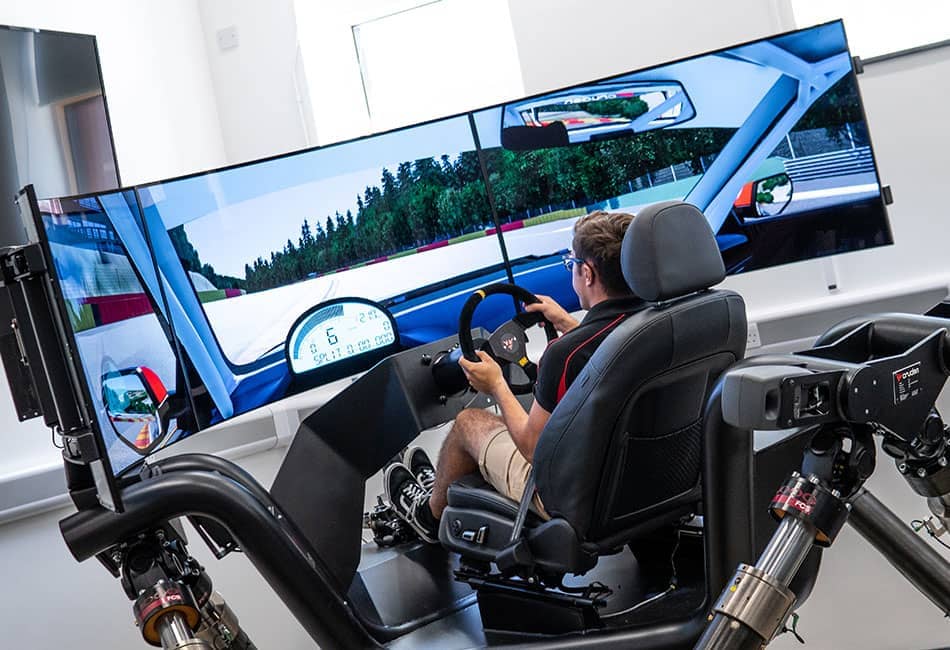
You will apply what you've learnt and develop vital professional skills, using the latest simulation equipment. As well as helping you develop the practical simulator skills demanded by employers, this equipment will enable you to assess performance before concepts are built.
You will test designs on our state-of-the-art driving simulator that utilises a Formula One monocoque and a wrap-around screen and can be programmed to test concepts on any car type and test-drive these on a range of terrains. Plus, test fuelling and ignition systems on our dedicated motorcycle rolling road.
Take a Virtual Tour of the Engineering facilities and see what's on offer here for you.
Personalised virtual tour
There's no need to visit us in person to explore our facilities and campuses. Take a personalised virtual tour and discover it all for yourself from wherever you are.
Take a virtual tourCareers
Careers / Further study
You could work in automotive research and development, design, manufacture and maintenance.
With green transport technologies a focus of future transport developments, opportunities for eco-minded automotive engineers are predicted to increase.
Depending on your year two results, you could transfer to our four-year MEng Automotive Engineering course, which would give you a master's rather than a bachelor's degree.
With a MEng, you fully meet the academic requirements to become a Chartered Engineer with the Institution of Mechanical Engineers.
Get inspired
Our award-winning careers service will develop your employment potential through career coaching and find you graduate jobs, placements and global opportunities.
We can also help find local volunteering and community opportunities, provide support for entrepreneurial activity and get you access to employer events.
Visit our employability pages to learn more about careers, employers and what our students are doing six months after graduating.
Take a look at the Engineering building
Step inside our new School of Engineering building at UWE Bristol.
Life

Accommodation
An excellent range of options for all of the Bristol campuses and the city centre.

Bristol
A stunning city for student living with all the qualities to make you want to stay.

Sports, societies and activities
There is more to your experience here than study. Choose to make the most of it and try new things.

Health and Wellbeing
We provide support in the way you need it.
Campus and facilities
Discover our campuses and the wealth of facilities provided for our students.