BSc(Hons) Product Design Technology
This course is open for applications.
Accreditations and partnerships:

6th university in the UK for Product Design courses.Guardian University Guide 2026
Learn how to design great products on a friendly and creative course with tutors who are highly experienced professional designers.
About
Why study product design technology?
Product design technology combines creativity and practicality to bridge the gap between product design and design engineering.
The industry needs graduates with the ability to create innovative concepts and transform them into real working products.
You may also be interested in our BA(Hons) Product Design course.
Why UWE Bristol?
BSc(Hons) Product Design Technology will give you the creativity, skills and confidence to take exciting concepts and transform them into real, working products.
Learn from friendly tutors with extensive industry expertise and work on a series of projects in our well-equipped Design Studio.
Examine real problems, grow your understanding of people and their needs, and develop innovative solutions. Gain advanced skills in concept sketching, making working prototypes, engineering analysis, computer-aided design (CAD), design for manufacture and beyond.
Work on design briefs for a range of industry clients. Past organisations have included Jaguar Land Rover, Dremel Bosch, Omlet and Virgin Marussia Formula 1. Take part in exhibitions and grow your network at industry presentations.
Graduate with the skill and confidence to create innovative products and build a successful career in the creative industries.
Where can it take me?
As a graduate, your in-depth understanding of technology, sustainability and materials will equip you for a range of careers.
Most of our graduates go into product development roles for design consultancies, or join in-house design teams for manufacturers and major brands.
Many are inspired to launch their own products or establish themselves as freelance design consultants.
Take a look at our online showcase of student projects from from our graduating students across the College of Arts, Technology and Environment.
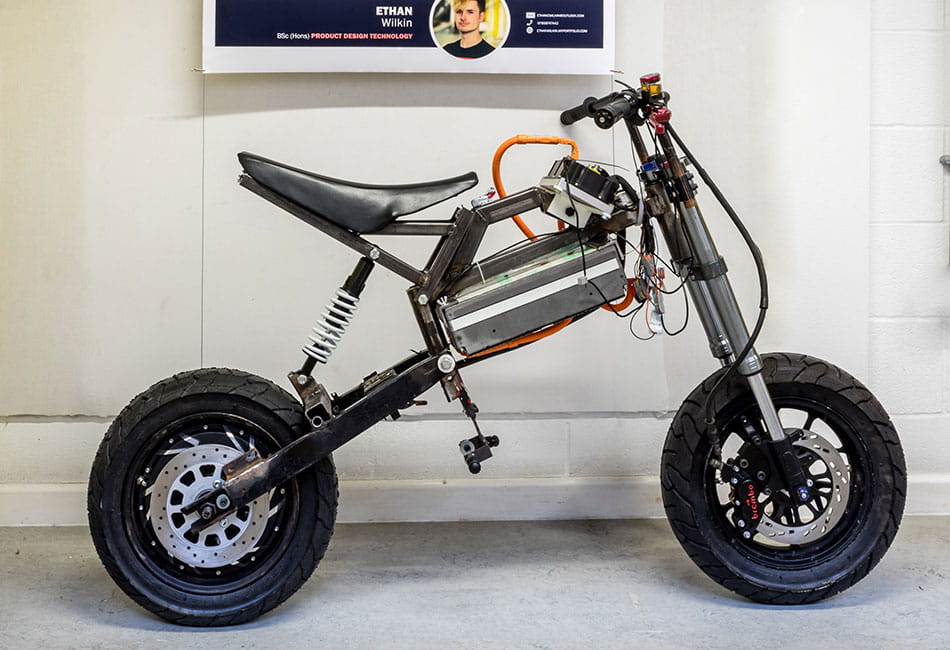
The image above shows the fantastic work from one of our students (Ethan Wilkin, 2022 Product Design Technology graduate).
Watch: Why I chose Product Design
Entry
Typical offers
You will need to meet the following Level 2 requirements:
- GCSE: Grade C/4 in English and Mathematics, or equivalent.
In addition to the above Level 2 qualifications, you'll need to achieve the published tariff points from your Level 3 studies prior to entry. Below is an indicative list of the main qualification types. However, we will consider any Level 3 qualifications towards meeting our entry requirements.
- Tariff points: 112
- Contextual tariff: See our contextual offers page.
- English Language Requirement:
International and EU applicants are required to have a minimum overall IELTS (Academic) score of 6.0 with 5.5 in each component (or approved equivalent*).
*The university accepts a large number of UK and International Qualifications in place of IELTS. You can find details of acceptable tests and the required grades you'll need on our English Language Requirements page.
- A-level subjects: A2 in one of the following subjects: Art and Design, Biology, Chemistry, Computing/Computer Science, Design and Technology, Electronics, Engineering, ICT, Maths/Further Maths, Music Technology, Physics, Product Design, Statistics.
- BTEC: You must be studying one of the following: Aeronautical Engineering; Applied Science; Art and Design; Construction and the Built Environment; Creative Media Production; Electrical / Electronic Engineering; Engineering; Land-based Technology; Manufacturing Engineering; Mechanical Engineering; Operations and Maintenance Engineering; Production Arts; or similar.
For information on required Guided Learning Hours please see our minimum entry requirements page.
- Access:
15 Level 3 credits at Merit in one of the following subjects: Art and Design; Design and Technology; Mathematics; Product Design; or similar.
- Baccalaureate IB:
To include a pass at Higher Level in one of: Design Technology; Mathematics; Visual Arts; Aeronautical Engineering; Applied Science; Art and Design; Construction and the Built Environment; Creative Media Production; Electrical/ Electronic Engineering ; Engineering; Land-based Technology; Manufacturing Engineering; Mechanical Engineering; Operations and Maintenance Engineering; Production Arts; or similar. We accept the IB Career-related Programme in conjunction with other Level 3 qualifications.
- Irish Highers: Higher Level in one of the following: Art; Biology; Chemistry; Engineering; Geography; Mathematics; Physics; Technology.
- Welsh Baccalaureate: We accept tariff points achieved from the Advanced Skills Baccalaureate Wales in conjunction with other Level 3 qualifications. This qualification cannot be used to satisfy any subject specific entry requirements.
- Cambridge Technical: You must be studying one of the following: Mechanical, Electrical and Electronic Systems Design and Engineering; Engineering Automation Control and Manufacturing Processes; Electrical and Electronic Engineering; Mechanical Engineering and Design; Automation, Systems and Control; Manufacturing; Applied Science; Digital Media; Art & Design or Information Technology.
- T Levels: Design and Development for Engineering and Manufacturing Maintenance, Installation and Repair for Engineering and Manufacturing Engineering, Manufacturing, Processing and Control Craft and Design
Entry requirements
Selection process
We're looking for applicants who are curious, creative and eager to develop their practice, explore new ideas and contribute to a vibrant creative community.
- Applicants studying qualifications that we've identified as subject-relevant will be considered on the basis of their predicted or achieved grades, provided they meet our entry requirements.
- Applicants whose qualifications fall outside these subject-relevant areas will be asked to submit a digital portfolio. This helps us consider creative potential alongside academic achievement. For more details, please visit our selection page.
In some cases, we may also invite applicants to a short online discussion about their work and creative interests.
Our admissions approach is designed to be fair, inclusive and supportive. We recognise both academic achievement and creative potential, ensuring you have the opportunity to demonstrate your suitability for the programme in a way that reflects your individual strengths.
International applicants
If you're applying to UWE Bristol from another country or region, visit the international study pages for tailored application information. If you're an international student and don't meet the academic requirements to study this course, you can qualify by completing preparatory study at our International College.
If you're applying to study at UWE Bristol and require additional support to meet our English language requirements, you may be able to attend one of our pre-sessional English courses. Read more about our pre-sessional English Programme.
Read more about entry requirements.
How to apply
Read more about undergraduate applications.
Read more about international applications and key international deadline dates.
For further information
- Email:
UK applicants
Admissions@uwe.ac.ukInternational/EU applicants
International@uwe.ac.uk - Telephone:
UK applicants
+44 (0)117 32 83333International/EU applicants
+44 (0)117 32 86644
Structure
Content
You'll study:
Design Contexts
This module introduces you to the subject of design and a suite of different cross-discipline design methods, supporting you to think about design holistically and understand its broader remit and application.
Studio 1
This studio module will introduce core interior design practices through project-based exploration. You'll develop ideas in response to briefs, using research, experimentation and iterative design to investigate relationships between people, space, material and context. Drawing, modelling and visual communication will help you test and present spatial proposals, while studio discussion and feedback will support critical reflection. You'll build confidence in making design decisions, documenting your process and selecting appropriate methods and materials, establishing practical and conceptual foundations for later interior design study.
Design Communication
This module will develop the communication skills used to explore and present design ideas. You'll work with a range of two-dimensional, three-dimensional and digital methods, which may include drawing, modelling, photography and computer-based visualisation. Through practical exercises, you'll learn how to select suitable techniques for different stages of the design process, from initial observation and concept development to resolved presentation. The module will strengthen your visual literacy, technical confidence and ability to communicate spatial, material and contextual information clearly to different audiences.
Mechanisms and Structures
In this module, you'll explore the mechanical and structural principles that influence how products work. Applied project work will introduce forces, moments, equilibrium, mechanisms, machines, work, energy and power, alongside stress, strain, torsion, beams and frames. Topics may also include springs, pressure, friction, centre of gravity, balance and buckling. Through mathematical analysis, observation and physical prototyping, you'll develop the ability to investigate behaviour, identify constraints and apply technical understanding when creating and evaluating mechanisms and structures within design projects.
You'll study:
Design Futures
You'll develop a future-orientated mindset for design, rooted in an understanding of the evolving and complex nature of global challenges. This module emphasises the role of design in addressing global challenges through interdisciplinary thinking and collaboration.
Studio 2
This studio module will develop your creative practice through a sequence of design projects. You'll respond to briefs by researching contexts, generating ideas, testing possibilities and refining outcomes through an iterative process. Studio activity will help you connect conceptual thinking with practical making, while tutorials, discussion and feedback will support critical development. You'll consider how decisions about form, materials, users, communication and presentation shape a project. By managing increasingly complex work, you'll strengthen your independence, visual communication and ability to resolve and present coherent design proposals.
Product Design Engineering
This module will build your product design engineering knowledge through project-based learning. You'll apply mathematical, mechanical and electronic engineering principles to design problems, developing physical and digital prototypes to test ideas. Topics may include physical computing, electronic components, failure analysis and approaches to extending product lifespan. You'll use appropriate methods such as hand calculations, two-dimensional techniques, computational analysis, finite element analysis, CAD and digital prototyping. Throughout, you'll learn to recognise technical risk and select suitable engineering methods for particular design challenges.
Design for Manufacture
This module will develop the detailed design and communication skills needed to enable products to be manufactured to the correct specifications. You'll investigate material properties and processes across polymers, metals, ceramics, composites and other materials, considering forming, moulding, casting, fabrication, assembly, finishes and quality assurance. Through research, prototyping and testing, you'll evaluate ideas with stakeholders and user groups and use feedback to inform final decisions. Sustainability, colour, material and texture will help you consider both technical performance and visual or tactile experience.
Optional modules:
Placement year (if applicable)
If you study on the four year (sandwich) course, you'll spend a year away from the University on a work placement after year two.
You'll study a placement module.
See the Placements and Fees sections for more information.
You'll study:
Design Research Project
Through the production of work that could take the form of still or moving image, practice, sound or writing, you'll develop your critical and creative thinking skills - connecting practical outcomes to a deeper analytical, theoretical and contextual backdrop.
Final Major Project
This module will provide the opportunity to complete an independent major design project that reflects your chosen professional direction. Working from a self-written brief, you'll develop ideas through critical research, concept generation, experimentation and prototyping before producing a resolved design outcome. The project encourages creative confidence, independent decision-making and an awareness of social and environmental considerations within design practice. By drawing on knowledge developed across your programme, you'll strengthen your ability to communicate complex ideas and deliver innovative solutions to a professional standard.
Studio 3
This module will help you consolidate the research, design practice and professional skills developed throughout your studies. Taking a holistic approach to your work, you'll refine and present materials that support future career progression and demonstrate your readiness for professional practice. Activities may include the development of portfolios, exhibitions, marketing materials, professional profiles and research documentation. Through studio-based learning, tutorials and critical discussion, you'll strengthen your ability to communicate design ideas, engage with diverse perspectives and position your work within wider professional contexts.
Innovation, Technology and Design
This module will examine the relationship between innovation, technology and contemporary product design practice. Through advanced design projects, you'll explore how emerging technologies, materials and processes can be applied to address complex future-facing challenges. Topics may include prototype development, product specification, ergonomics, manufacturing considerations, mechanical design and advanced computational techniques. Supported by project-based learning and technical investigation, you'll develop systematic approaches to design problem-solving while strengthening your ability to create and communicate innovative technology-driven solutions.
If you complete the sandwich placement year, you'll take the 15 credit version of the Final year module Innovation, Technology and Design, whereas if you don't complete the Sandwich placement year, you'll take the 30 credit version instead.
The University continually enhances our offer by responding to feedback from our students and other stakeholders, ensuring the curriculum is kept up to date and our graduates are equipped with the knowledge and skills they need for the real world. This may result in changes to the course. If changes to your course are approved, we'll inform you.
"I completed several live projects in collaboration with real-world companies, such as Omlet. Also, the industry contacts I gained helped me to find freelance opportunities. I'm now employed as a freelance 3D artist while working on releasing my own products." Almario, Product Design Technology graduate.
Learning and Teaching
Our lecturers all have years of professional practice within the design industry. Along with an emphasis on hands-on learning, this gives the course professional practice focus that will prepare you for your career in design.
The course is project-led and taught mainly in studios. Apply your new knowledge to diverse projects that solve human-centred problems through design practice.
Focus on learning technical skills such as using computational stress analysis to design the structure of products.
Get intensive one-to-one mentoring with tutors for practical guidance on your work. Attend guest lectures with professional designers and receive help with your CV and interview skills from our partner organisations.
Lay a foundation in professional design skills including 3D design, sketching, concept generation, presentations, computer-aided design (CAD) and practical workshops. Gain an understanding of people and their complex emotional relationships with products.
Learn about human-centred design, co-design and innovative design processes, materials and manufacturing and form and aesthetics development.
Work on a range of studio projects with real companies (Brabantia, Dremel, Bloodhound and Piper Moto). Research, develop and create a product that will demonstrate your skills in the design area you'd like to grow in.
See our full glossary of learning and teaching terms.
Showcase your work
Showcase your final year projects to family and friends, as well as regional employers at the annual degree show.
Graduates also exhibit at the New Designers exhibition in London, where awards and media interest are a springboard for careers.
Assessment
You'll be assessed mostly on your project work and the presentation of a portfolio of design and development studies. Four modules include conventional exams as a form of assessment.
Learn more about assessments.
Fees
Full time course
Supplementary fee information
Please note, the above tuition fees for home students are charged in the first academic year of study but may increase in subsequent years for both new and continuing students. This increase will track the tuition fee cap which is determined by government and is expected to increase in line with inflation. UWE Bristol will likely maintain its fees for new and returning home students at the maximum permitted level for each year of study.
The placement year fee will also increase when the fee cap changes so please use the above placement year fee for indication purposes only.
The additional costs listed are those that students could reasonably expect to incur during their studies and are for items not covered by the standard tuition fee. These could be materials, text books, travel, clothing, software or printing.
For information about funding for undergraduate courses see our funding pages.
Features
Professional accreditation
This degree allows you to become a member of the Institution of Engineering Designers (IED), giving you professional recognition, access to events and opportunities on their website.
Placements
Students who get work experience tend to graduate with better degrees. Experience also hones your skills, industry knowledge and professional network, making you highly employable on graduation.
If you choose the four year (sandwich) course, you'll spend a year away from the University on a work placement after year two.
We have placement opportunities in the UK and Europe, US and China. Past students have worked for in-house design teams, consultancies and manufacturers such as Opel cars, Disney, Omlet, Kinneir Dufort, Trunki, Mathmos and Mira Kohler.
You'll get help to find your placement and support throughout from staff within the School and our award-winning careers service.
Fieldwork
We arrange day trips so you can visit study locations and meet people that can inform your work. We also arrange residential field trips locally, nationally and internationally.
Study facilities
Learn in modern, well-equipped school facilities that simulate industry.
Study and collaborate on group assignments in our dedicated Project Room. Brainstorm concepts in our dedicated design studios.
Develop CAD, model-making, design and drawing skills in integrated studios.
Make models and prototypes and use 3D printers, laser cutters and computer numerical control (CNC) routers in our product design workshop.
This mix of traditional and highly creative learning environments enables you to learn essential knowledge and real-world skills, standing you in good stead for your professional career.
Learn more about UWE Bristol's facilities and resources.
Take a personalised virtual tour of the Design facilities and experience what a typical day could look like here for you.
Personalised virtual tour
There's no need to visit us in person to explore our facilities and campuses. Take a personalised virtual tour and discover it all for yourself from wherever you are.
Take a virtual tourCareers
Careers / Further study
After graduating, you'll find career opportunities all over the world.
Potential creative roles include product design, industrial design, design engineering, user experience, graphic or web design, teaching, and exhibition and packaging design.
Many graduates have launched their own products or established themselves as freelance design consultants.
We have strong links with local companies who provide graduate jobs. Most of our graduates go straight into product development roles for design consultancies or join in-house design teams for manufacturers and major brands.
Read how UWE Bristol alumni Kieran Devlin wins the UK Young Innovators Award from Innovate UK and the Princes Trust.
Get inspired
Our award-winning careers service will develop your employment potential through career coaching and find you graduate jobs, placements and global opportunities.
We can also help find local volunteering and community opportunities, provide support for entrepreneurial activity and get you access to employer events.
Visit our employability pages to learn more about careers, employers and what our students are doing six months after graduating.
Watch: Welcome to the School of Arts at UWE Bristol
Life
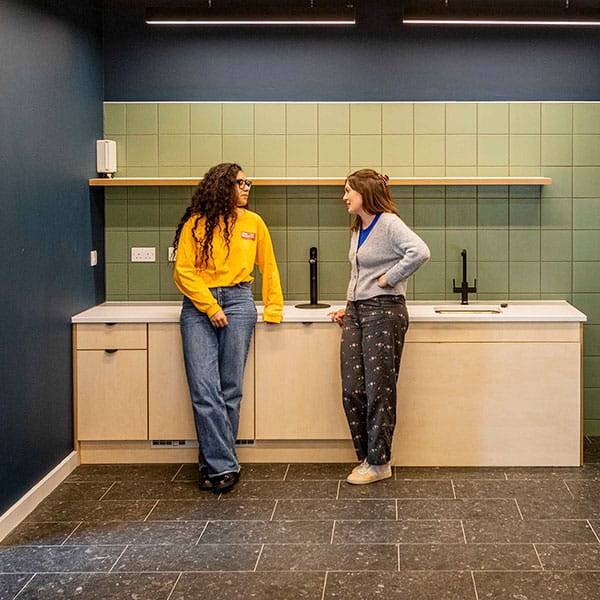
Accommodation
An excellent range of options for all of the Bristol campuses and the city centre.
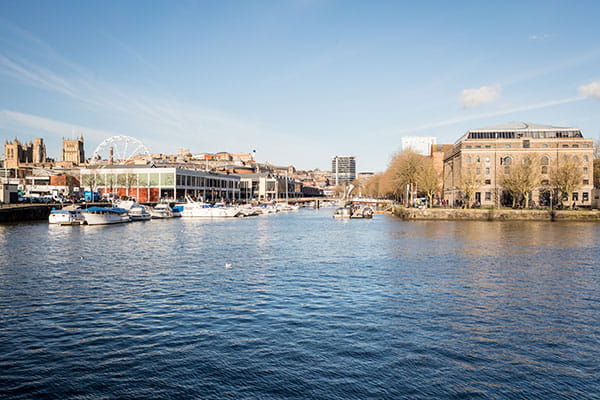
Bristol
A stunning city for student living with all the qualities to make you want to stay.

Sports, societies and activities
There is more to your experience here than study. Choose to make the most of it and try new things.

Health and Wellbeing
We provide support in the way you need it.
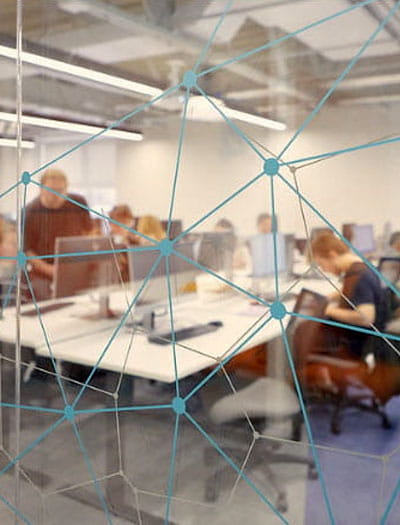
Campus and facilities
Discover our campuses and the wealth of facilities provided for our students.